
Transforming Web Navigation: How Discriminative World Models Revolutionize Agent Action Selection
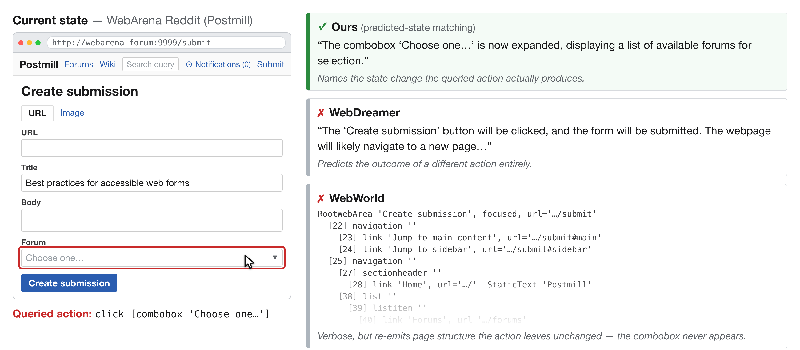
Web navigation is inherently complex, often requiring agents to make multiple decisions based on dynamically changing environments. A recent breakthrough, presented in the research paper Discriminative World Models for Web Agents by Kelvin Li and colleagues, introduces a novel approach aimed at improving how web agents predict and select actions by leveraging the concept of predicted-state matching. This innovative framework enables agents to better differentiate between potential outcomes of various actions, ultimately leading to more effective navigation and task completion.
The Challenge of Web Navigation
At its core, web navigation is a multi-step decision-making problem. Agents must analyze the current webpage and interaction history, predict how future actions will affect these states, and select the best action amongst competing alternatives. Traditional methods often rely on simple, reactive next-action prediction, where agents choose an action based solely on the current observation and past history. However, this doesn't consider the potential consequences of different actions, which can significantly limit performance.
Introducing Predicted-State Matching
The researchers propose a shift from the traditional supervised next-state prediction models to a more dynamic approach known as predicted-state matching. Instead of generating a static representation of the next state, this method focuses on producing representations that can distinguish the true resulting state of a given action from alternative potential states reached by other actions. The model trains using a specially designed dataset that organizes decision points where multiple actions can lead from the same current state, providing the necessary insights to train the agent more effectively.
Significant Findings and Performance Improvement
The experimental results are compelling. The research showed that models utilizing predicted-state matching outperformed existing world models trained through traditional methods in achieving higher accuracy for state predictions. This innovation not only enhances the understanding of what happens after taking specific actions but also aids in better scoring and ranking those actions through a process reward model (PRM), thereby improving the overall success rate of web navigation tasks by up to 28.48% in specific trials.
Real-World Applications and Future Directions
The implications of this research extend far beyond academic interest. Improved decision-making capabilities could open the door for more sophisticated web agents capable of navigating complex online environments, thus providing enhanced user experiences. The potential for integrating these findings into services such as automated customer support, online search agents, and virtual shopping assistants is vast. As this technology continues to evolve, researchers are eager to explore its applications in diverse web environments and with various agent models.
In conclusion, the introduction of predicted-state matching for web agents represents a significant leap forward in the field of artificial intelligence. By concentrating on action-relevant differences in predicted states and accommodating a more dynamic understanding of web navigation, this research lays the groundwork for the next generation of intelligent web agents.
Authors: {Kelvin Li, Dhruv Pendharkar, Anish Pahilajani, Chuyi Shang, Leon Oks, Leonid Karlinsky, Rogerio Feris, Trevor Darrell, Roei Herzig}




