
Unleashing 3D Imagination: How Imagine3D-LLM Revolutionizes Scene Understanding
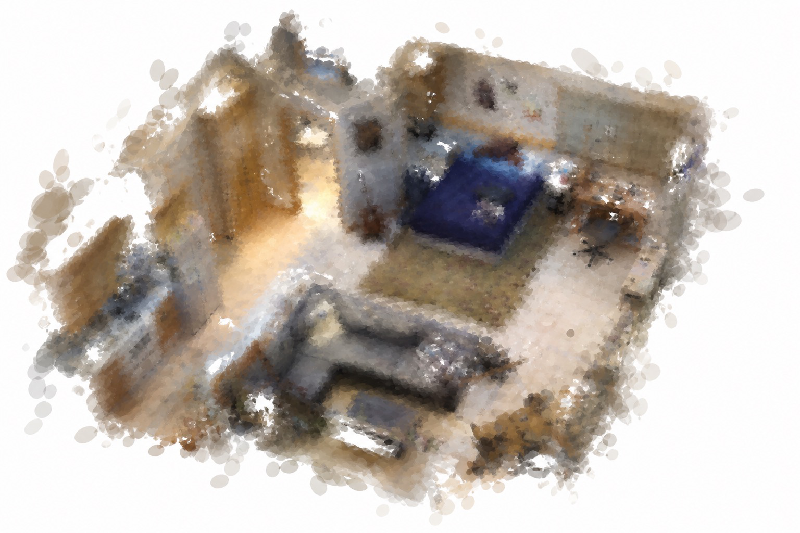
A groundbreaking study introduces Imagine3D-LLM, a novel Multimodal Large Language Model (MLLM) poised to redefine how machines interact with and interpret 3D environments. Leveraging an innovative framework that mimics human cognitive processes, this model demonstrates a remarkable ability to imagine and reconstruct 3D scenes before providing answers, elevating spatial reasoning capabilities above traditional techniques.
Understanding 3D Scene Reconstruction
Traditional MLLMs excel at processing single images. However, they often struggle when confronted with multiple views of a scene, which require genuine 3D reasoning. Imagine3D-LLM addresses this challenge by utilizing a unique set of learnable Gaussian tokens that summarize multi-view information into a compact 3D representation. Rather than focusing solely on pixel-wise accuracy, this model grasps the larger picture, allowing it to comprehend spatial relationships among objects more naturally.
Inspired by Human Cognitive Processes
Drawing inspiration from how humans perceive and mentally reconstruct their surroundings, Imagine3D-LLM does not rely on fine-grained geometry but instead identifies common objects across different viewpoints. This allows the model to form a conceptual understanding of space in a manner akin to human mental processes. The model's architecture incorporates a set of Gaussian summary tokens that unify overlapping visual information from various perspectives, fostering an emergent understanding of the scene.
Innovative Training Methodology
Through joint training with a photometric reconstruction loss, the model improves both its 3D awareness and its language understanding capabilities. This novel approach has shown to enhance cross-view correspondence in image features, allowing for sharper and more organized representations. The model consistently outperforms previous state-of-the-art methods across several benchmarks, suggesting that its ability to "imagine" 3D layouts leads to better reasoning abilities compared to relying solely on pixel-wise reconstruction.
Performance and Benchmarks
In rigorous testing against seven spatial reasoning benchmarks, Imagine3D-LLM has significantly outperformed prior models, highlighting the effectiveness of its compact 3D scene reconstruction approach. For instance, it achieved state-of-the-art results in Real-3DQA, a benchmark specifically designed for evaluating 3D reasoning capabilities. This performance underscores the model's superiority in tasks requiring understanding of spatial dynamics and relationships.
A Step Towards Human-like 3D Reasoning
The implications of Imagine3D-LLM extend beyond mere technical advancements; they signify a leap toward developing AI systems capable of processing and understanding spatial environments with the sophistication comparable to human cognition. Additionally, the researchers emphasize the practicality of their approach, as it maintains lower computational costs than many existing models, allowing broader accessibility for applications ranging from robotics to augmented reality.
Conclusion
The introduction of Imagine3D-LLM marks a pivotal moment in AI research, combining sophisticated 3D scene understanding with advanced language modeling. By rethinking how machines visualize and interpret the world around them, this model opens new avenues for creating more intelligent, autonomous systems capable of complex reasoning. The future of AI interaction has just become a bit more imaginative.
Authors: {Jaewoo Jung, Hyeonseo Yu, Honggyu An, Jisang Han, Mungyeom Kim, Minkyeong Jeon, Heeseong Shin, WonJun Moon, Federico Tombari, Daniel Barath, Marc Pollefeys, Seungryong Kim, Sunghwan Hong}


