
Unleashing Cosmic Forces: How Colliding Bubbles in the Early Universe Create Heavy Particles
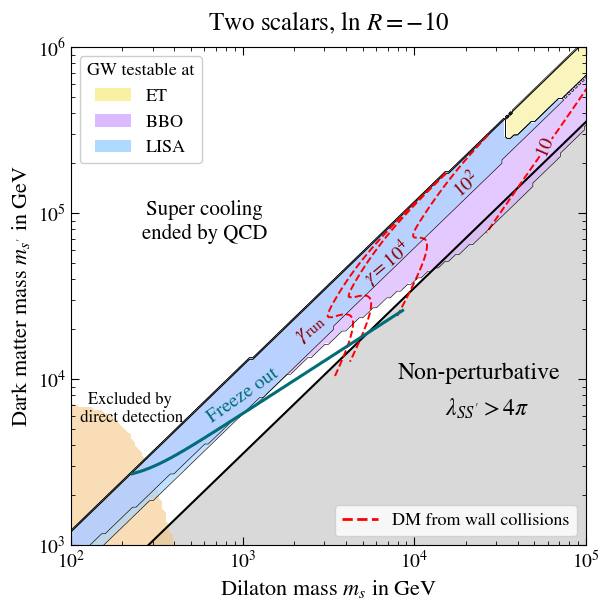
Recent research has unraveled a fascinating mechanism by which collisions of ultra-relativistic bubbles could produce heavy particles in the early universe, offering insights into fundamental questions about dark matter and gravitational waves. This innovative work, led by Anish Ghoshal from the University of Sussex and collaborators from Oklahoma State University and the University of Pisa, challenges previous models by introducing a new framework that could reshape our understanding of particle production during cosmological phase transitions.
Understanding the Bubble Collision Mechanism
The study focuses on events occurring during strongly first-order cosmological phase transitions, where bubbles of new vacuum may expand and collide. Traditional models have treated these collisions similarly to off-shell quantum decays, leading to overestimated particle production rates. Ghoshal and his team propose a novel approach that treats these bubble collisions akin to high-energy particle collisions—a partonic model—that accurately reflects the physics when Lorentz factors become extraordinarily large.
The Shift from Off-Shell to On-Shell Dynamics
Previously, researchers modeled particle production based on an off-shell approximation, which is susceptible to gauge dependence and other inaccuracies. The authors argue that this framework results in misleading outcomes about the amount of energy transferred during these collisions. Instead, their analysis suggests that when two immense and rapidly expanding bubbles collide, they pass through one another without creating a significant amount of off-shell particles, thus only scattering on-shell particles—akin to particles bouncing in a high-energy collider.
Implications for Dark Matter and Gravitational Waves
These findings have profound implications for our understanding of dark matter. By providing a more accurate measure of how particle production occurs, the research suggests new ways to explain dark matter abundance through these bubble collisions. Moreover, they explored how gravitational waves might originate from the dynamics of particles produced during these events. The research points out that the gravitational wave signals resulting from these high-energy processes could provide unique insights into the very early universe.
Future Directions
As researchers continue to explore the cosmos's fundamental mysteries, this study opens avenues for further investigation. The need to refine our understanding of particle dynamics during the early universe not only enhances our grasp of cosmology but may also provide essential information regarding potential new physics beyond the Standard Model. Subsequent studies will undoubtedly delve deeper into these implications, potentially impacting our understanding of everything from the nature of dark matter to the formation of the universe itself.
In conclusion, Ghoshal and his colleagues pave the way for a richer understanding of how the universe's dramatic beginnings might influence the particle physics we observe today. The implications of their research extend from fundamental theoretical physics to practical observational data, as scientists seek to uncover the complex interactions of matter and energy in the cosmos.
Authors: Anish Ghoshala, Pratyay Pal, Alessandro Strumia




