
Unlocking High-Quality UI Generation with Small Models: The New Era of Cost-Efficiency
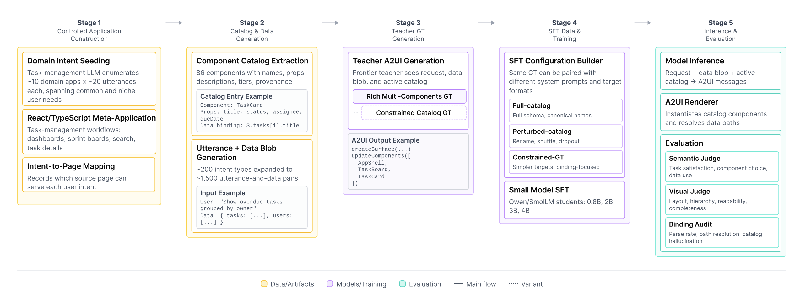
In an age where web applications are rapidly evolving, the ability to generate interactive user interfaces (UIs) at lower costs without compromising quality has become paramount. A recent study led by a team from Amazon explores the potential of small language models in achieving frontier-quality UI generation through declarative protocols, particularly the A2UI framework. The findings are promising: small models can produce UIs with nearly indistinguishable quality compared to larger counterparts, at a fraction of the cost.
The Power of Declarative UI
Declarative UI protocols like A2UI allow developers to create interactive interfaces by selecting components from an existing catalog, reducing the need for ground-up coding. This not only enhances safety and consistency in production systems but also simplifies the developer's task, enabling a faster iteration process. The question driving this research was straightforward: can small models maintain high-quality UI generation while being cost-effective?
Methodology: A Systematic Approach
The research focused on three key design aspects: the supervised fine-tuning (SFT) data construction method, the size of the model, and the richness of the component catalog. In an innovative setup, the researchers tested various combinations of these factors across different model sizes, finding that even a 4 billion parameter model could achieve approximately 98% semantic and 97% visual quality akin to larger, more robust models used in industry.
Key Findings: Quality, Cost, and Flexibility
The results unveiled several crucial insights:
- Cost-Effectiveness: The fine-tuned small models exhibited over an order of magnitude in cost savings compared to leading commercial models, offering a viable option for organizations aiming to streamline their development processes.
- Strategic Advantages: Two augmented strategies in data construction were found to outperform traditional methods, enhancing both reliability and quality. Specifically, the Perturbed-catalog method excelled in maintaining high semantic quality while Constrained-GT focused on improving data binding accuracy.
- Catalog Richness Matters: The study also revealed that even smaller models benefit from a rich catalog of components, with quality metrics improving significantly as the number of components increased from around 10 to upwards of 100.
Practical Implications for Developers
For practitioners in the field, these findings underscore a turning point in UI development. The researchers recommend leveraging the Perturbed-catalog strategy with a 4B model as a default approach for dynamic UI generation. This ensures high quality while keeping costs manageable. For simpler, in-distribution queries, even a smaller model (around 0.8B) remains a viable candidate as long as quick responses are prioritized.
Conclusion: The Future of UI Generation
This research illuminates a path toward greater efficiency and accessibility in UI generation, suggesting that small models can indeed rise to the challenge of demanding coding tasks. With the power of declarative protocols and intelligent training strategies, developers can produce high-quality UIs that meet modern standards without incurring excessive costs.
As the demand for interactive and dynamic web applications continues to grow, innovations like these stand to significantly impact the way developers approach UI design, making it more accessible than ever before.
Authors: Yingxiang Yang, Weihang Xiao, Ben Bullough, Tushar Deshpande, Niresh Agarwal




