Unlocking Market Signals: How Volatility Estimators Illuminate Stress in Local Food Markets
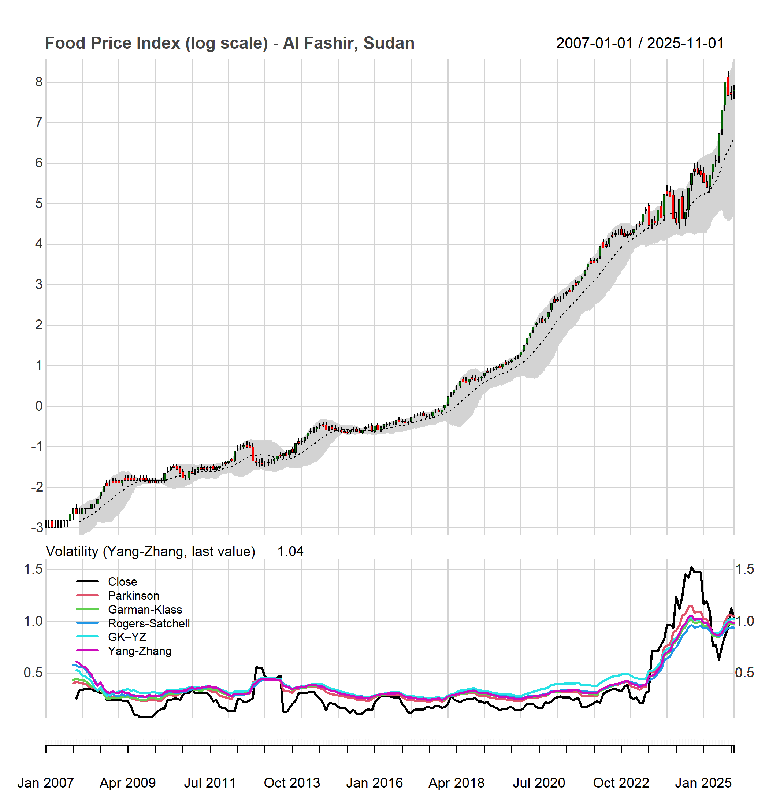
In a groundbreaking study, Bo Pieter Johannes Andrée from the World Bank introduces a novel approach to understanding market stress by employing range-based volatility estimators, traditionally reserved for financial markets, to analyze local food price data. This method creates a new lens through which we can monitor economic instability, especially in regions affected by conflict or climate change.
The Challenge of Monitoring Market Stress
Understanding market conditions is essential for policymakers and humanitarian organizations, yet traditional methods often fall short in rapidly changing environments. Price levels alone do not capture the complexities brought about by insecurity, natural disasters, or supply chain disruptions. This paper argues that merely observing prices can obscure critical signs of distress that volatility can reveal.
What Are Range-Based Volatility Estimators?
Range-based volatility estimators utilize the open, high, low, and close (OHLC) prices to analyze the fluctuations within a given period. Unlike standard methods that focus solely on closing prices, these estimators evaluate the entire price range, providing deeper insight into market behavior. For example, volatility can highlight situations where prices swing dramatically even if they eventually settle back to normal levels, revealing underlying market dysfunction that traditional measures might overlook.
Key Findings from the Study
The research utilized the World Bank’s Real-Time Prices dataset, consisting of monthly food prices across various regions experiencing diverse shocks, such as conflict, climate change, and economic policy disruptions. Through several case studies including Sudan, Somalia, and Haiti, it was found that spikes in price volatility often correlate with real-world events like armed conflicts, natural disasters, and policy changes.
One of the standout findings was that these volatility indicators can flag significant market distress that conventional metrics, such as the relative strength index (RSI), might miss. For instance, during conflict-driven price swings, volatility often increased even when average prices stayed relatively stable, demonstrating that while prices might not reflect urgency, the underlying economic conditions could be dire.
Implications for Policy and Humanitarian Efforts
The application of these volatility measures offers practical advantages. They are computationally efficient and can be easily integrated into existing monitoring systems, providing timely alerts that can inform decision-makers. By shifting focus from mere price levels to volatility, organizations can better prepare for and respond to market disruptions, potentially saving resources and lives in crisis situations.
As global monitoring systems strive for resilience in food security and economic stability, incorporating volatility measures into their analytics toolkit could enhance their effectiveness, especially in unpredictable environments.
Conclusion
This pioneering work presents a compelling case for redefining how we monitor market stress. By applying financial econometric techniques to local food markets, Andrée’s study opens up a new frontier for researchers and policymakers focused on economic stability and humanitarian issues. In a world where market conditions can change overnight, understanding volatility might just be the key to navigating the uncertainties ahead.
Authors: Bo Pieter Johannes Andrée, World Bank

