
Unlocking Material Mysteries: How Neural Operators Revolutionize Constitutive Model Discovery
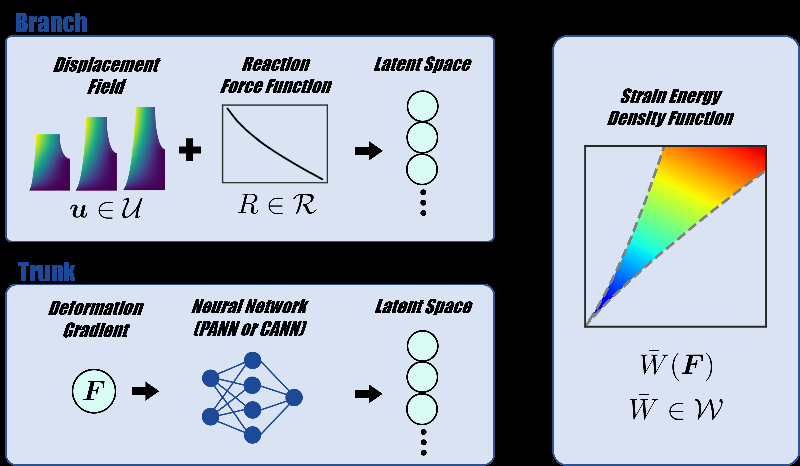
In a groundbreaking study, researchers from top institutions like the Friedrich-Alexander-Universität Erlangen-Nürnberg, University of Cambridge, and Stanford University have developed innovative neural operator architectures—namely, Physics-Augmented Neural Operators (PANO) and Constitutive Artificial Neural Operators (CANO). These advancements promise to streamline the process of discovering the mechanical properties of materials, traditionally a time-consuming endeavor dictated by complex optimization problems.
What Are Constitutive Models?
Constitutive models are mathematical descriptions that predict how materials respond to applied forces. They're essential for simulations in engineering, helping to understand everything from how buildings withstand earthquakes to how medical devices interact with body tissues. Traditionally, obtaining accurate constitutive models requires calibrating model parameters through extensive experimental data, often involving iterative computational calculations. This research introduces a vastly more efficient alternative.
Neural Operators: A Game-Changer
Traditionally, deriving constitutive models involved optimization techniques that are computationally expensive and often leave researchers waiting for results. The new neural operator approaches, PANO and CANO, create direct mappings between measurable data from experiments—like displacement fields and reaction forces—to the strain-energy density functions that characterize material behavior. This allows for rapid material characterization with a single evaluation, freeing engineers from extensive and time-consuming optimization processes.
Robustness and Flexibility
One of the most compelling aspects of the new models is their robustness against noisy and incomplete experimental data. The neural operators can effectively handle data from varied discretizations and dimensions of testing geometries. This flexibility is particularly beneficial in real-world conditions where experimental measurements may not always be perfect. By integrating physics constraints into their design, the neural operators ensure that the derived models adhere to fundamental physical principles, which enhances their predictive accuracy and reliability.
Ill-Posed Inverse Problems: Tackled
The study also tackles the issue of ill-posed inverse problems, which often arise in material characterization. By constraining the design space of potential solutions using physical admissibility principles, the researchers were able to regularize the problems they faced. This means that even with limited data, the neural operators provide meaningful parameter estimates that mitigate the inherent uncertainty of inverse problems.
Conclusions and Future Directions
The implications of this research are huge for fields like material science and engineering. In addition to enhancing efficiency, these methodologies could pave the way for more accurate and faster material model discovery. Looking forward, the researchers propose to extend their framework to include diverse geometries and explore the use of alternative basis functions to further enhance the performance of their neural operators.
By harnessing the unique capabilities of neural networks, PANO and CANO not only push the envelope in computational mechanics but also set the stage for a future in which discovering material properties is quicker, more efficient, and significantly less daunting.
Authors: Moritz Flaschela, Burigede Liub, Ellen Kuhla




