
Unlocking Personalized Recommendations: How AgentWebRec Transforms Evidence Fusion in the Agent Web
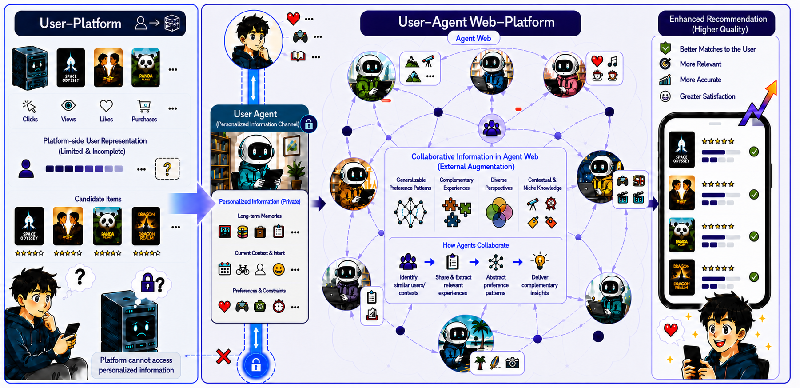
In a groundbreaking study, researchers have introduced a novel approach to personalized recommendation systems through a framework known as AgentWebRec. This innovative method taps into the capabilities of Large Language Model (LLM)-based personal agents, reshaping the way users interact with recommendation platforms.
What is AgentWebRec?
AgentWebRec addresses the challenges presented by distributed information sources in the evolving landscape of personalized recommendations. Traditionally, these systems rely heavily on centralized user-platform interactions, which often leads to limited understanding of user intentions and dynamic preferences. In contrast, AgentWebRec leverages a User-Agents-Web-Platform model where user agents act as intermediaries that can accumulate richer user data and interact with various platforms effectively.
The Advantages of an Agent Web
One of the core insights from the research is that the typical user-platform interaction is significantly enhanced when framed as an Agent Web. This reconfiguration allows user agents to draw on decentralized knowledge from other agents, complementing their local data without necessitating a complete centralization of information. Instead of simply aggregating user behaviors, AgentWebRec intelligently queries and fuses relevant evidence from various sources, creating a task-time acquisition and fusion approach.
How Does It Work?
The framework operates on an interactive query-response model that aims to filter and acquire only the most relevant evidence for a specific recommendation task. Here's a simplified breakdown of its functionality:
- Semantic Enhancement: When a user is seeking recommendations, the target user agent first queries the platform agent for enriched semantic descriptions of the items in question.
- Private Memory Retrieval: The user agent then retrieves relevant records from its own memory, using the enhanced semantic context to guide its search for relational patterns in past interactions.
- Collaborative Support: If the local memory does not yield sufficient evidence, the user agent can conditionally query neighboring agents to gather complementary preferences, thereby enriching the decision-making process.
Experimental Success
To validate the efficacy of AgentWebRec, the authors conducted experiments on four datasets from the InstructRec benchmark. The results demonstrated a significant improvement in performance over existing recommendation methods, particularly in personalized rankings. The experiments highlighted how the structured acquisition of task-relevant evidence, coupled with collaborative inputs from fellow agents, consistently yields superior recommendation results.
Conclusion
The research presents a substantial leap forward in the field of recommendation systems. By transforming how user preferences and item interactions are processed and utilized, AgentWebRec provides a framework that not only enhances personalization but also encourages a more nuanced understanding of user behavior within the Agent Web ecosystem. As recommendations become increasingly integral to user experiences across digital platforms, the implications of this methodology are profound.
For those interested in the future of personalized recommendations, AgentWebRec stands as a pivotal advancement, promising a more intelligent, collaborative approach to connecting users with the content they care about.
Authors: Haoran Qiang, Guannan Liu, Liang Zhang, Junjie Wu


