
Unlocking the Dual Dynamics of Causality: A Revolutionary Approach to Signal Processing on Product DAGs!
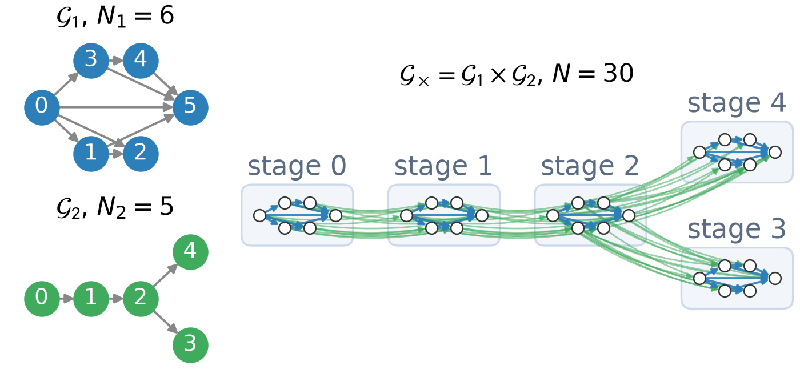
In an era defined by complex data structures and interdependent systems, a ground-breaking research paper sheds light on new methodologies for signal processing over product Directed Acyclic Graphs (DAGs). Authored by a collaborative team from renowned institutions in India, Spain, and the USA, this research presents a novel framework that can significantly enhance how we interpret and manipulate signals across linked domains.
The Challenge of Traditional Graph Signal Processing
Graph signal processing (GSP) borrows concepts from spectral graph theory to analyze data that can be structured as graphs. However, when it comes to edges with directionality, particularly in DAGs, traditional methods falter. The established techniques for processing signals face scalability issues due to the complexities arising when two domains interact— for example, in production systems where components are linked to both manufacturing stages and quality conditions.
Introducing Product DAGs: A Game-Changer
The core innovation of the paper is the introduction of a new definition of product DAGs. Unlike standard graph products that often lead to non-separable systems, the novel product operator retains the causal structure of the graphs involved. This allows for the extraction of key insights from complex multi-domain data, facilitating a more intuitive understanding of the system's dynamics.
Key Findings: Causal Filters and Denoising
One significant takeaway from the research is the development of separable convolutional filters tailored for product DAGs. These filters not only simplify the processing of signals but have also been validated through rigorous tests. By efficiently denoising signals across different domains, the proposed methods promise better accuracy and performance compared to conventional techniques.
Practical Applications and Future Implications
This research holds vast implications for various fields, including recommendation systems and spatio-temporal analysis. By leveraging the unique factorization properties of product DAGs, industries can enhance their data processing capabilities, leading to improved decision-making processes. Looking ahead, the authors envision extending the framework to encompass more complex filtering methods beyond rank one, enhancing its applicability in a wide range of scenarios.
Conclusion
In summary, the introduction of product DAGs and the associated innovations in causal shift operators and filters mark a significant advancement in the landscape of graph signal processing. As industries increasingly turn to interconnected data structures, this research provides invaluable tools to enhance interpretability and operational efficiency. The journey towards a deeper understanding of complex systems continues, paving the way for transformative technological advancements.
Authors: Sundeep Prabhakar Chepuri, Antonio G. Marques, Maulik Devmurari, and Gonzalo Mateos


