
Unlocking the Dynamics of Conversational Capture: How Human-Agent Interactions Change Information Retrieval!
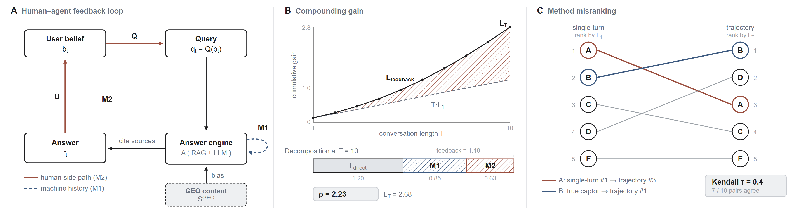
In a world increasingly dominated by artificial intelligence, the way we interact with technology can dramatically shape the results we receive. A groundbreaking study titled "Conversational Capture: A Trajectory-Level Framework for Evaluating Generative Engine Optimization in Multi-turn Human-Agent Interaction" introduces a new framework for understanding how information retrieval systems operate during prolonged dialogue with users.
Understanding Conversational Capture
The research, led by Junwei Yu from The University of Tokyo and several collaborators, reveals a fascinating phenomenon called "conversational capture." This concept describes how sources mentioned early in a multi-turn conversation become significantly more likely to be referenced later. Essentially, when users communicate with an AI or a chatbot, the answers they receive don't just respond to their immediate questions; they actively shape their subsequent inquiries.
The Limitations of Single-Turn Evaluation
Traditionally, generative engine optimization (GEO) has been evaluated based solely on single-turn interactions, where the effectiveness of a response is measured in isolation. However, this study argues that such methods fail to account for the evolving nature of conversations. The researchers assert that the real influence of an information source accumulates throughout an ongoing dialogue, rather than being confined to individual exchanges.
The Innovative Two-Layer Framework
Yu and his team propose a two-layer closed-loop system to evaluate the trajectories of conversations. This framework separates the "machine-side" capture, where retrieval is influenced by the previous dialogue history, and the "human-side" capture, which reflects how users change their questions based on prior answers. By analyzing these channels independently, the authors introduce several new constructs for measuring conversational effectiveness, including cumulative conversational visibility and feedback terms.
The Impact of Cumulative Gains
This research demonstrates that GEO's cumulative payoff grows significantly across multiple conversation turns. For instance, if an initial source is favored early on, its chances of being cited later increase, leading to a compounding effect that can misrepresent the source's relevance if evaluated only through isolated turns. The findings show that traditional evaluation might underestimate the benefits of certain optimization methods, prompting the need for a reevaluation of how we measure success in generative engines.
Implications for Future Design
The implications of this study extend beyond theoretical frameworks; they suggest critical design changes for AI and search engine interactions. By understanding how conversational capture works, developers can create more robust systems that mitigate biases and prevent misinformation from reinforcing itself. For instance, mechanisms to promote source diversity or provide transparency over why a particular response was generated can enhance trust and information quality.
In summary, this research unveils the intricate dynamics of how conversations flow and evolve, urging technologists to rethink their approaches to AI interactions. As conversational agents become more prevalent in our daily lives, understanding these principles can lead to systems that not only respond accurately but also guide users toward a more comprehensive understanding of the information landscape.
Authors: Junwei Yu, Jieyu Zhou, Mufeng Yang, Yepeng Ding, Hiroyuki Sato


