
Unlocking the Future of AI Training: How fDRACO Revolutionizes Long-Horizon Agent Learning
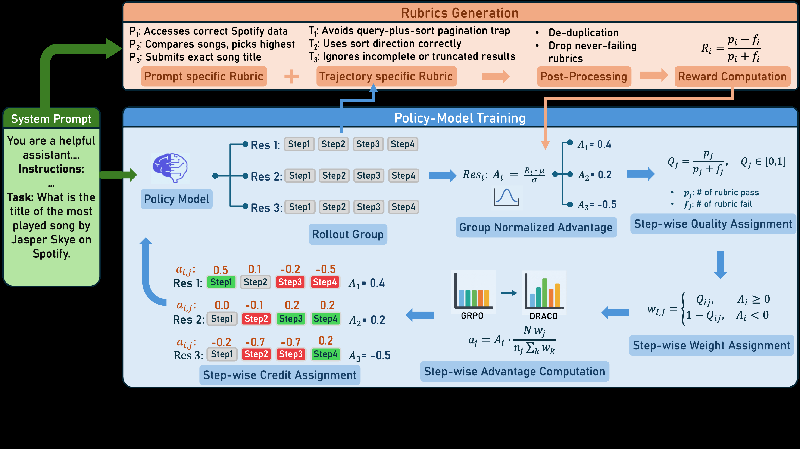
The latest research paper titled fDRACO: Fine-Grained Credit Assignment with Dynamic Rubrics for Long-Horizon Agent Training introduces an innovative method for training AI agents, particularly in environments where success cannot be programmatically verified. Developed by researchers from Carnegie Mellon University and IBM, this approach addresses a significant gap in reinforcement learning: the ability to assign credit for individual actions over lengthy and complex tasks without relying on outcome-based rewards.
The Challenge of Long-Horizon Tasks
Traditional reinforcement learning techniques often depend on clear success indicators to provide feedback to agents. However, many real-world applications, such as customer service interactions or exploratory research, lack such definable success signals. This gap presents a challenge, as agents must learn from the process, not the outcome. The authors define an "outcome-blind" setting where agents derive rewards solely from process criteria, as opposed to established success metrics.
Introducing DRACO: A Dynamic Solution
DRACO (Distributing Rubric-based Advantage for Credit Optimization) is the proposed solution to the aforementioned challenges. Instead of using a static rubric, which does not adapt to the agent's evolving capabilities, DRACO creates dynamic rubrics tailored to each specific task trajectory. This allows for continuous evaluation throughout the process, leading to a more nuanced understanding of which actions contribute to success.
In simpler terms, DRACO works by generating detailed rubrics that can change over time, assigning credit for steps within a task dynamically. It monitors how well the agent follows these dynamic criteria and redistributes rewards accordingly. This way, even if an agent eventually fails to complete a task, it can still learn from its intermediate steps, such as how well it handled specific subtasks.
Impressive Results and Adaptability
In testing DRACO on benchmark tasks like AppWorld and τ-bench, the researchers reported significant improvements in performance metrics. On the AppWorld benchmark, DRACO outperformed existing models by a substantial margin, achieving a task goal completion rate of 85.3%, a marked increase compared to untrained models.
Even more intriguing is DRACO's ability to adapt to multiple task domains without special training, showcasing its potential role in more generalized applications, such as interactive AI systems in customer service or automated research assistants.
Final Thoughts
The introduction of DRACO represents a paradigm shift in how we think about teaching AI systems to operate autonomously over long periods, especially in environments where measuring success is complex or ambiguous. By focusing on dynamic, rubric-based evaluation rather than static success metrics, this research could pave the way for more resilient and capable AI agents in diverse fields.
For more details, you can reach out to the lead author Shubham Gandhi at srgandhi@andrew.cmu.edu.




