
Unlocking the Future of Time Series Forecasting: The Power of Latent Inference-Time Guidance
In the realm of data science and machine learning, accurately predicting future events based on historical data is a crucial task. Recent advancements have led to the evolution of Time Series Foundation Models (TSFMs), which offer remarkable capabilities for forecasting. However, uncertainties around model sensitivity and variations in performance have posed challenges to their effectiveness. A groundbreaking research paper titled “Latent Inference-Time Guidance of Time Series Foundation Models” proposes a novel approach that addresses these challenges, paving the way for enhanced predictive accuracy.
What Are Time Series Foundation Models?
Time Series Foundation Models are models that utilize massive amounts of data to learn patterns and predictions about future events based on historical sequences. The power of these models comes from their ability to leverage in-context learning, which means they can adapt to new data on-the-fly without needing to be relearned from scratch. This significantly reduces the time and resources needed for training. Yet, their reliance on user-selected parameters can lead to inconsistencies in forecasting accuracy, as varying inputs can yield vastly different results.
Introducing Latent Inference-Time Guidance (LITiG-TSFM)
The key innovation introduced in this research is Latent Inference-Time Guidance (LITiG-TSFM). This technique aims to unify the forecasts generated by multiple TSFMs through a smart, structured probabilistic framework that preserves the core models’ capabilities while enhancing prediction accuracy. By combining the strengths of different models into a cohesive forecast, LITiG-TSFM allows for more reliable decision-making processes in areas such as finance, climate science, and energy management.
How LITiG-TSFM Works
At its core, LITiG-TSFM operates on the principle of adaptive guidance through a time-dependent latent state, which encodes how each forecast should be weighted over time. This method captures the inherent dependencies in time series, enabling better predictions even under complex conditions. Importantly, this innovative framework does not require retraining existing TSFMs, thereby simplifying implementation while maintaining data integrity and accuracy.
Experimental Success and Applications
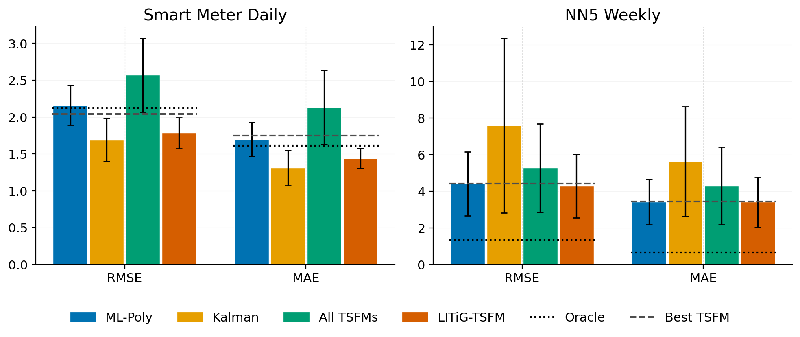
The researchers conducted extensive experiments across various datasets that spanned different domains, including energy consumption, climate data, and financial trends. The results demonstrated that LITiG-TSFM consistently outperformed traditional ensemble approaches, displaying robustness against the introduction of weaker forecasting models and adapting effectively to chaotic data environments.
The Road Ahead
As we navigate the ever-evolving landscape of data science, the advancements highlighted in this research signify a promising future for time series forecasting. The ability of LITiG-TSFM to intelligently synthesize forecasts positions it as a transformative tool in various fields, from predicting electricity demand patterns to forecasting climate changes with greater precision. The implications of these findings may revolutionize how we approach data-driven decision-making, establishing a new benchmark for forecasting capabilities across industries.
In conclusion, the introduction of Latent Inference-Time Guidance in Time Series Foundation Models not only enhances predictive accuracy but also addresses the fundamental challenges faced by traditional forecasting methods. As industries continue to leverage data for strategic insights, adopting such advancements will be key to staying ahead in a data-driven world.
Authors: Chloé Hashimoto-Cullen, Amaury Durand, Laurent Bozzi, Benjamin Guedj, Yannig Goude, Sylvain Le Corff


