
Unlocking the Potential of Language Models: How Distribution Matching Distillation Revolutionizes Text Generation!
In a groundbreaking study, researchers have unveiled the transformative capabilities of distribution matching distillation for continuous diffusion language models. This innovative method significantly reduces the costs associated with generating high-quality text while maintaining impressive levels of quality and diversity in language generation.
The Challenge of High-Quality Text Generation
Text generation in language models often demands extensive computational resources, requiring up to hundreds of network evaluations to produce merely a few tokens of text. This inefficiency can be particularly burdensome for applications relying on real-time or cost-effective solutions. Continuous diffusion language models emerged as a promising approach by generating tokens in parallel, yet they too suffer from substantial evaluation costs.
Introducing Distribution Matching Distillation
To address this pressing issue, the authors of the study employ a technique known as distribution matching distillation, which leverages a ‘teacher-student’ framework. Here, a pretrained teacher model guides a student model through the text generation process. By aligning the student's output distribution with that of the training data, the method seeks to produce high-quality text with a reduced number of network evaluations.
A Unified Framework: Simplex-DMD and Reinforce-DMD
The research presents two novel methods—Simplex-DMD and Reinforce-DMD—both rooted in a unified framework for distributional distillation. Simplex-DMD adopts a continuous relaxation approach, enabling efficient gradient estimations, while Reinforce-DMD draws samples from the categorical output of the model, using advanced score estimation techniques.
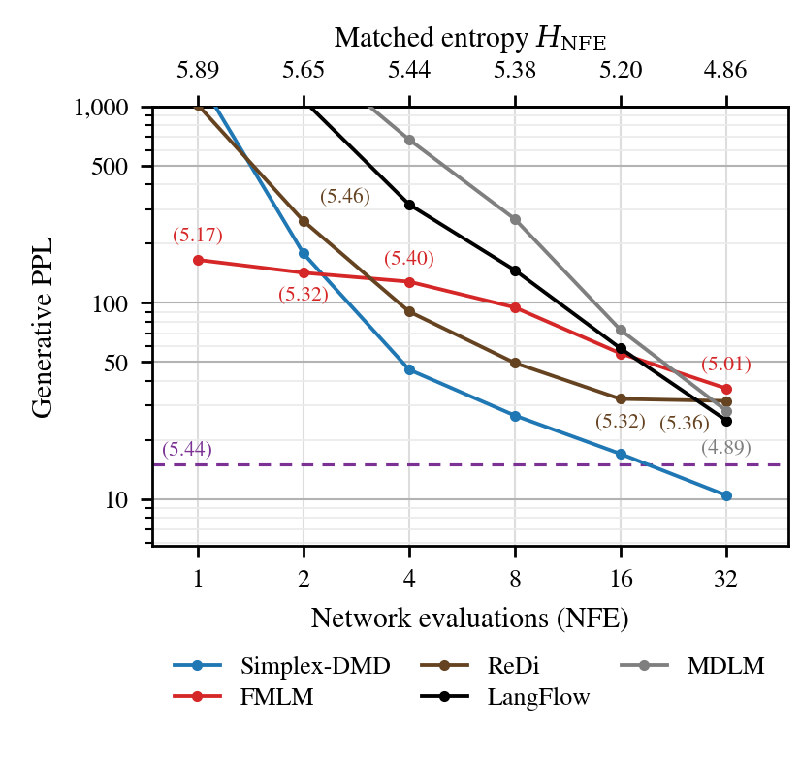
Key to the success of these methods is their performance on OpenWebText, where Simplex-DMD achieved a generative perplexity score of 45.6 after just 4 network evaluations, marking a 49% improvement over traditional methods. Meanwhile, Reinforce-DMD reached a perplexity of 14.9 at a budget of 256 evaluations, showcasing its substantial efficiency.
Quality vs. Diversity: Striking the Right Balance
A critical aspect of text generation involves balancing the quality of output with diversity. The two methods excel in different computational settings—Simplex-DMD thrives in low-budget scenarios while Reinforce-DMD demonstrates superior capabilities at larger budgets. This complementary performance showcases the potential of combining different distillation techniques for varied applications.
Conclusion: The Future of Language Models
The findings from this research illuminate a promising path forward for language generation, aiming to make high-quality text production more accessible and efficient. By harnessing distribution matching distillation principles, future models may achieve unprecedented levels of performance, paving the way for more advanced applications in natural language processing, artificial intelligence, and beyond.
Authors: Paul Le Van Kiem, Dario Shariatian, Umut Simsekli, Alain Durmus


