
Unlocking the Secrets of City Traffic: How teLLMe is Shaping Causal Analysis in Urban Driving
Urban traffic congestion is a complex problem, often exacerbated by unpredictable weather and peak travel times. A new research breakthrough from Rutgers University introduces teLLMe, a cutting-edge system designed for exploratory causal analysis of urban driving data. It provides insights into how various factors, such as weather and time of day, affect traffic conditions, equipping city planners and traffic analysts with a novel tool for better decision-making.
Understanding teLLMe: A Game-Changer in Traffic Data Analysis
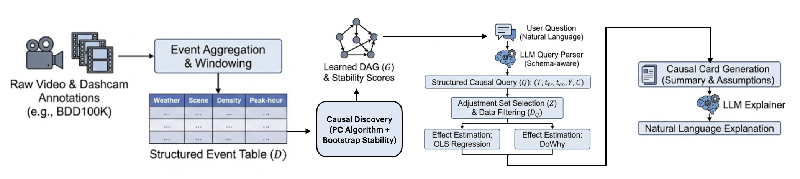
teLLMe transforms vast amounts of observational traffic data, primarily derived from dashcam footage, into structured insights. Traditional observational data often struggles with nuanced questions like "How does rain impact traffic density?" due to confounding factors and lack of interventions. teLLMe addresses these challenges by integrating causal structure learning with advanced algorithms like the PC algorithm and DoWhy.
The system works by converting user-friendly natural language queries into structured causal analysis tasks. Users can ask questions directly, such as "What is the effect of rainy weather on traffic density during peak hours?" teLLMe interprets these queries, selects relevant variables, and employs statistical methods to generate causal insights.
The Mechanics of Causal Analysis: How teLLMe Works
At the heart of teLLMe is its unique architecture designed for ease of use and robust analysis. First, it constructs a structured event table from dashcam annotations to create a comprehensive overview of traffic situations. This data undergoes causal analysis through a systematic approach that includes hypothesis generation and adjustment of confounding variables.
A standout feature is the system's ability to produce a "Causal Card," which summarizes effect estimates, adjustment sets, and supporting causal graphs. This format not only provides quantitative data but also delivers a plain-language explanation to non-technical users, making complex analyses accessible to city planners and policymakers.
Practical Applications: Real-World Case Studies
The efficacy of teLLMe is highlighted through its application to real-world questions about urban traffic. For instance, an analysis revealed that rain decreases traffic density at intersections, while peak-hour traffic noticeably increases density on highways. These results were derived from robust statistical examinations and validated through the system's transparent methodology.
Moreover, the flexibility of teLLMe allows analysts to see how different variables interact, making it a powerful tool for understanding the dynamics of urban traffic. The system's focus on keeping assumptions explicit helps ensure that the insights gathered can be relied upon for making informed decisions regarding urban traffic management and infrastructure planning.
Looking Ahead: Enhancing Urban Safety with teLLMe
As part of a broader initiative called Redddot, teLLMe aims to not only improve causal analysis of traffic data but also enhance urban safety and mobility analytics. This project envisions a platform where planners, researchers, and community stakeholders can access interpretable views of urban data, empowering them to make evidence-based decisions for better city navigation.
While teLLMe is a significant step forward, it's essential to note that all effects are based on assumptions made during the modeling process. Therefore, teLLMe serves as a guide for hypothesis generation rather than a definitive causal claim, highlighting the need for further investigation and validation in urban analytics.
The introduction of teLLMe marks a pivotal moment in urban traffic analysis, transforming video-derived datasets into actionable insights. As cities continue to grow and the challenges of congestion increase, innovations like teLLMe will play a crucial role in shaping safer and more efficient urban environments.
Authors: Qiwei Li, Jorge Ortiz, Rutgers University, Department of Electrical and Computer Engineering




