
Unlocking the Secrets of Cosmic Collisions: How Ultralight Bosons Illuminate Black Hole Mass-Spin Relationships
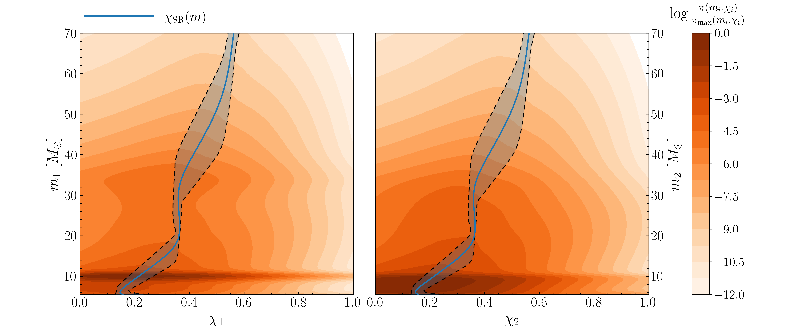
In a groundbreaking study, researchers have proposed that ultralight bosons—hypothetical particles with extremely low mass—could explain the intriguing mass-spin correlations observed in merging binary black holes (BBHs). This innovative research not only enhances our understanding of black hole physics but also sheds light on potential dark matter candidates, offering new insights into the universe.
The Essence of Superradiance
The concept at the heart of this research is "superradiance," a phenomenon where ultralight bosons can destabilize rapidly spinning black holes. When these particles interact with a spinning black hole, they extract some of its rotational energy, leading to the formation of oscillating boson clouds around the black hole. This interaction can significantly influence the spin of the black holes involved in mergers.
Linking Theory to Observation
In their analysis, the research team utilized data from the Gravitational-Wave Transient Catalogs (GWTCs) compiled from black hole merger signals detected by observatories such as LIGO and Virgo. By adopting a "superradiance-informed spin distribution model," the team compared the predicted mass-spin relationship of the black holes with the observed data from merging events.
The results were compelling: the researchers found a scalar boson mass near 10-12 eV that aligns well with the observed mass-spin correlations, especially in the later catalogs. The Bayesian analysis revealed a significant consistency in these findings, enhancing the credibility of the superradiance spin model. Specifically, the Bayes factor for the GWTC-5.0 data set reached approximately 7.8, indicating strong evidence for the proposed model.
Implications for Dark Matter Research
This research has broader implications beyond black hole physics. The identified mass range of ultralight bosons corresponds to viable dark matter candidates such as axions and dark photons. These particles, which are predicted in various models beyond the Standard Model of particle physics, could unify several areas of astrophysics and particle physics by providing a potential connection between dark matter and black hole physics.
Future Directions
As researchers continue to analyze gravitational wave data, the findings from this study pave the way for future investigations into the existence of ultralight bosons. Upcoming observational campaigns may provide even more precise measurements, potentially allowing for the direct detection of these elusive particles. Furthermore, exploring the effects of various non-gravitational interactions could refine our understanding of how these bosons influence black hole dynamics.
In conclusion, the insights gained from this research not only enhance our comprehension of black holes but also stimulate exciting discussions about the nature of dark matter in the cosmos. As gravitational wave astronomy evolves, the quest to unveil the mysteries of our universe continues, with ultralight bosons now at the forefront of scientific inquiry.
Authors: {Xiao-Xiao Kou, Vuk Mandic, Ran Ding, Chi Tian}




