
Unlocking the Secrets of Escher: A New Method for Generating Recursive Imagery
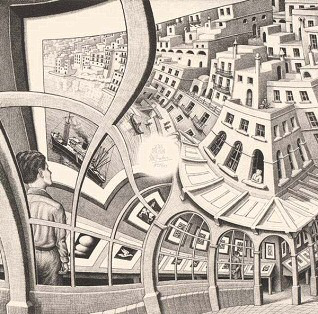
A groundbreaking study from researchers at the Technion - Israel Institute of Technology brings to life the mesmerizing optical illusions of M.C. Escher through a novel mathematical approach. The paper delves into the geometry of Escher's work, particularly his iconic piece "Print Gallery," and proposes a sophisticated model to create self-referential images that challenge our perception of reality.
Escher's Inspirations: Art Meets Mathematics
Escher famously remarked on the peculiar nature of his prints, like the one featuring a young man observing an image of himself. This interplay between illusion and reality sparked the inspiration for the research, as the authors sought to use mathematical principles to replicate Escher’s recursive designs purposefully.
The study identifies notable limitations in previous methods used to generate self-similar images. Existing approaches often failed to maintain the geometric connections necessary for true recursion. This gap prompted researchers Sophia Feldman and Assaf Shocher to innovate a new method that effectively intertwines mathematics with computer vision to produce strikingly complex output.
The Conformal Golden Braid: Methodology Revealed
The heart of the paper lies in its introduction of a generalized inverse and a method referred to as braided sampling. This process employs two coupled representations of the same image—an untwisted source and its transformed version—to ensure that the self-referential nature of the image remains intact throughout the generation process.
In simpler terms, rather than merely applying transformations after an image is created (which often led to disjointed elements), the researchers dynamically weave mathematical transformations into each stage of the image generation. This results in a coherent composition where the source image and its recursive counterparts evolve simultaneously, creating harmonious connections between different parts of the artwork.
The Impact of Geometry on Artistic Interpretation
One of the remarkable findings from this study is how geometric constraints influence the effectiveness of AI-generated art. By leveraging Escher's graphical style, which often plays with space and perspective, the researchers are able to generate works that not only resemble Escher's but also expand upon the concepts he explored. The resulting images feature intricate details and maintain a clear sense of perspective and recursion, often reflecting themes of self-similarity and paradox.
This innovative approach provides artists and technologists with powerful new tools to explore the interplay between art and mathematics, through which they can create works that are both visually stunning and conceptually profound.
A Glimpse into the Future: Beyond Escher
As the field of generative art continues to evolve, this study exemplifies how combining advanced mathematical methods with artistic inquiry can lead to new creative possibilities. The principles outlined by Feldman and Shocher could inspire ongoing exploration of geometric art forms, potentially leading to broader applications in design, animation, and even architecture.
The authors invite the community to explore their findings further, promising that these deep connections between visual art and abstract mathematics will yield even more surprising results in the future. As Escher himself once said, “Originality is merely an illusion,” and with this fresh perspective, the boundaries of both art and mathematics seem poised to expand dramatically.


