
Unlocking the Secrets of Trypanosome Swimming: How Blood Cell Interactions Boost Parasite Mobility
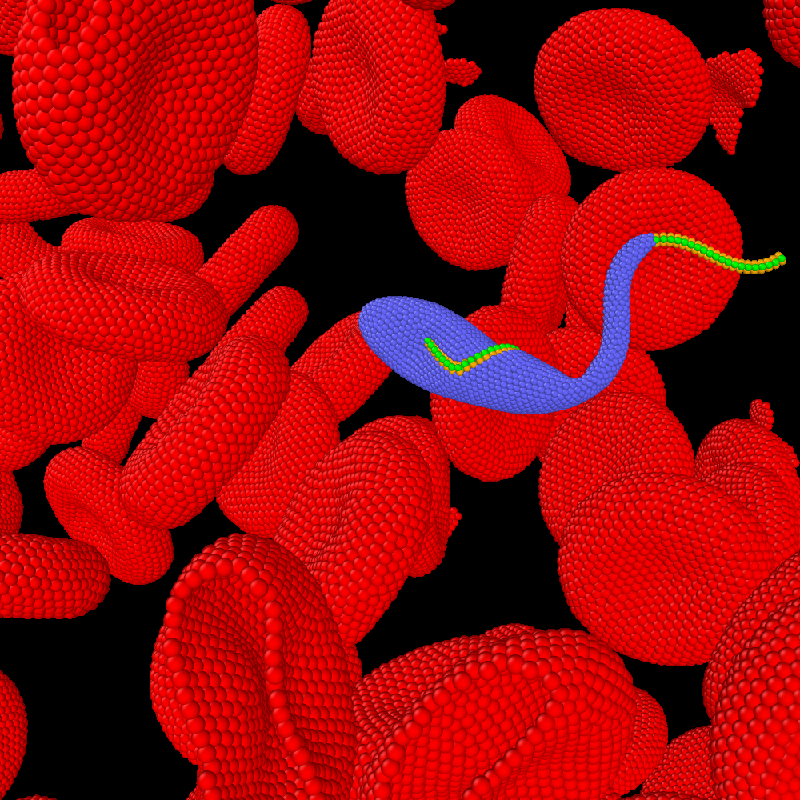
A groundbreaking research study sheds light on how the flagellate parasite Trypanosoma brucei navigates through the highly congested environment of the bloodstream. This research, which combines numerical simulations and in vitro experiments, reveals the surprising effects of red blood cells (RBCs) on the parasite’s locomotion, allowing it to swim more efficiently despite the density of its surroundings.
Understanding the Trypanosome Challenge
Trypanosoma brucei is notorious for causing sleeping sickness in humans and is typically found swimming in the crowded and viscous milieu of the bloodstream, where red blood cells occupy around 40-50% of the volume. Traditionally, it was thought that such crowded conditions would hinder motility, leading to lower speeds due to increased drag and collisions. However, recent findings challenge this notion.
Enhancing Propulsion through Particles
The study discovered that as the volume of red blood cells in the suspension increases, the swimming speed of the trypanosome improves by up to 50%. The researchers attribute this enhancement to the anisotropic friction the flagellum experiences when surrounded by these suspended particles. In simpler terms, the interaction between the trypanosome and the RBCs alters the way drag forces behave, essentially allowing the parasite to propel itself more effectively.
How Do They Do It?
The mechanism at play involves the flagellum, a whip-like structure the trypanosome uses to swim. The researchers found that when the size of the RBCs matches or becomes smaller than the wavelength of the flagellar beat, it creates conditions that favor propulsion. The suspended particles do not just add resistance; they actually create a favorable situation for the trypanosome to push against as it swims, thereby enhancing its speed.
Experimental Confirmation
To corroborate their simulations, the research team conducted experiments with controlled suspensions of microparticles. Results showed consistent increases in trypanosome propulsion with higher particle concentrations, affirming the hypothesis that the presence of RBCs significantly boosts swimming efficiency. This finding underlines how microorganisms might exploit their environments to enhance their movement.
Implications for Understanding Microbial Movement
This research not only enhances our understanding of Trypanosoma brucei locomotion but could also have broader implications for studying other flagellated microorganisms. By understanding how these tiny organisms adapt to complex environments, researchers can unlock potential new strategies for controlling diseases caused by such parasites.
As we learn more about the intricate dance between the trypanosome and its surroundings, we gain valuable insights into the adaptations of microorganisms that allow them to thrive in even the most challenging conditions.
Authors: Florian A. Overberg, Marie Kater, Timothy Krüger, Gerhard Gompper, Markus Engstler, Dmitry A. Fedosov




