Unlocking Urban Climate Solutions: A Novel Framework for Tailored Urban Vegetation Design
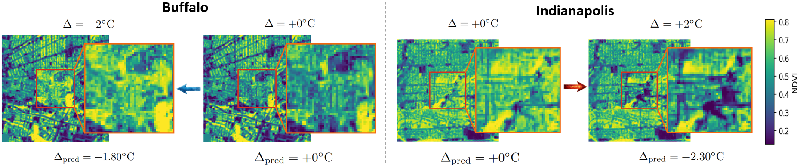
As urban areas grapple with the adverse effects of climate change, including rising temperatures and thermal extremes, researchers have initiated groundbreaking approaches to help cities adapt. A recent study from Purdue University presents a pioneering method for generating diverse urban vegetation patterns that can significantly influence local temperatures. This innovative research offers practical insights into urban planning and climate resilience.
Understanding the Challenge of Urban Heat
Urban regions are increasingly vulnerable to thermal extremes that arise from rapid urbanization and climate change. Vegetation plays a crucial role in moderating urban heat by providing shade and facilitating evapotranspiration, which cools the surrounding atmosphere. However, traditional methods of monitoring and modeling land surface temperatures often rely on satellite imagery, which does not address the complexities involved in configuring vegetation to achieve specific temperature goals.
The Novel Conflated Inverse Modeling Framework
The researchers introduced a revolutionary conflated inverse modeling framework capable of producing various physically plausible urban vegetation patterns tailored to specific temperature objectives. Unlike conventional approaches that typically yield averaged solutions, this model incorporates both a predictive forward model and a generative inverse model. This fusion allows for generating diverse vegetation configurations—even in scenarios lacking extensive training data.
Implementing the Framework
The framework leverages satellite imagery, including data on land surface temperature (LST), vegetation indices, and building heights. The predictive forward model estimates temperature based on vegetation cover, while the generative inverse model creates optimal vegetation layouts designed to either raise or lower temperature. This two-pronged approach ensures that diverse outputs meet specified regional temperature targets.
Significant Findings and Implications
The research findings revealed that the proposed framework enhanced the diversity of vegetation patterns by over three times and reduced control error in temperature predictions significantly compared to existing methodologies. This suggests that cities can utilize the model to strategically design and implement green spaces, thereby enhancing urban sustainability and comfort.
Future Perspectives
While the framework opens new avenues for urban climate adaptation, the researchers emphasize the need for further exploration. Future studies could incorporate architectural constraints and spatial rule-based considerations to optimize vegetation integration in real-world urban designs. This paradigm shift could redefine urban planning, paving the way for cities to become more resilient to climate change.
Ultimately, the proposed conflated inverse modeling approach not only advances scientific understanding but also provides practical tools that urban planners and policymakers can use to combat the growing issues associated with urban heat. This innovative research serves as a testament to the critical role that vegetation can play in creating sustainable and livable urban environments.
Authors: Baris Sarper Tezcan, Hrishikesh Viswanath, Rubab Saher, Daniel Aliaga

