
Unmasking Hidden Dangers: Distinguishing Physical Risks in Language Models
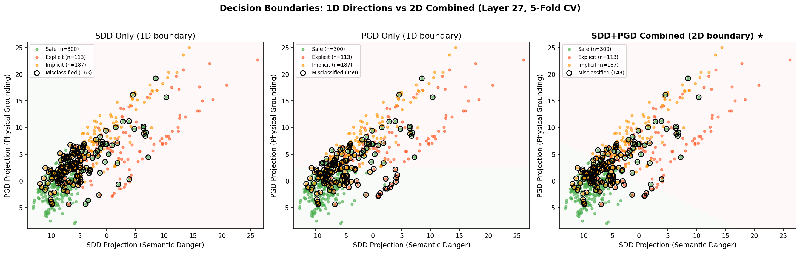
As artificial intelligence becomes more integrated into our daily lives, ensuring the safety of embodied agents using large language models (LLMs) poses significant challenges. A recent paper titled "When Words Are Safe but Actions Kill: Probing Physical Danger Beyond Text Safety in Hidden-State Risk Space" dives into how LLMs can misinterpret harmless instructions as dangerous actions when applied in the physical world. This research, led by a team from Tsinghua University and Nanyang Technological University, introduces a novel approach to address this issue.
The Distinction Between Content Danger and Physical Danger
The researchers reveal that not all perceived dangers stem from explicit harmful language. They distinguish between two types of danger: Content Danger (CD), defined by words that directly suggest harm (e.g., "ignite the curtain"), and Physical Danger (PD), where benign phrases turn harmful once linked to real-world actions (e.g., "microwave an egg"). This distinction is critical as traditional safety protocols mainly focus on content danger, leaving significant gaps in identifying physical risks.
Introducing PRISM: A Novel Probing Method
To tackle the safety issues presented by physical danger, the authors introduced PRISM (Probing Representations for Integrated Safety Monitoring). This approach uses a single-layer logistic probe to classify instructions based on their hidden states within an LLM’s architecture. In essence, PRISM evaluates whether an instruction is safe or unsafe, effectively bridging the gap between content and physical dangers.
In practical tests, PRISM achieved a remarkable accuracy rate of 99.6% on a newly developed benchmark known as PhysicalSafetyBench-1K, which assesses 1,000 instruction pairs without explicit harmful keywords. This underscores the method's capability to recognize dangers that are not overtly articulated in language.
The Implications of Hidden-State Analysis
The research emphasizes that physical safety is a uniquely identifiable component in the hidden layers of LLMs, separate from standard content safety. By analyzing hidden states, the researchers demonstrated that CD and PD exhibit distinct characteristics, allowing safer and more accurate discernment of risks associated with LLM-directed actions.
This finding suggests that merely relying on textual safety measures is insufficient to ensure the safe execution of instructions in the real world, leading to potential hazards when LLMs guide decision-making for robots or other embodied systems.
Conclusion: Towards Safer AI Integration
As AI technology advances, understanding and mitigating the unique risks posed by embodying language models in physical environments is essential. The findings from this research hold significant promise for better safety measures, making it possible to prevent harmful misinterpretations of seemingly innocuous instructions. Moving forward, the effectiveness of PRISM and similar methodologies promises to enhance the reliability of AI systems in varied real-world applications.
In conclusion, the journey towards secure and efficient AI integration continues, with innovative approaches like PRISM leading the charge in ensuring that when it comes to embodied agents, safety measures evolve in tandem with technological advancements. Ensuring AI understands not just the language but also the physical implications of its interpretations could be a game-changer in AI ethics and safety.
Authors: {Weimeng Wang, Ziqiang Wang, Zihang Zhan, Chuanpu Fu, Qi Li, Ke Xu}




