
Unpacking Consumer Trust and Choice in the AI Assistant Market: What Users Really Want
A new study sheds light on how adult users in the United States select AI assistants like ChatGPT and Gemini, revealing insights into platform preferences, task allocation, trustworthiness, and privacy concerns. Conducted with a representative sample of 1,999 participants in June 2026, the research provides a crucial understanding of the evolving landscape of consumer behavior in the AI assistant market.
The Dominance of Market Giants
According to the research, the AI assistant market is heavily skewed toward a few platforms, with ChatGPT and Gemini leading the pack. The data shows that 58% of users primarily use ChatGPT, while 25% prefer Gemini. Interestingly, smaller platforms like Claude are also carving out their niches; despite having only a 7% overall market share, Claude captures a remarkable 33% of coding tasks. This highlights a differentiated market where some platforms excel in specific tasks rather than across the board.
Trust: Earned Through Experience
One of the most striking findings of the study revolves around trust. The research underscored that users' trust in these AI platforms is primarily built through personal experience rather than brand reputation. Claude ranked as the most trusted platform among users who have experience with it, enjoying a remarkable 76% top-three trust ranking compared to only 41% among non-users. This indicates that, unlike established players like ChatGPT and Gemini, newer platforms need to demonstrate their reliability to earn users' trust.
The Privacy Paradox: Concern vs. Action
While privacy concerns are significant—over 80% of users express anxiety about how their data is handled—a gap exists between concern and action. The study reveals that knowledge about data-handling practices is more predictive of protective behavior than mere concerns. For instance, knowing whether a platform trains on conversations can influence users to adopt protective measures, highlighting that privacy behavior is more about being informed than simply worried.
Valuing Privacy: Dollars and Sense
The research also introduced a unique perspective on how much users value aspects of privacy. In a discrete-choice experiment, respondents indicated they would pay an average of $11.20 per month to prevent human review of their conversations. This valuation significantly exceeds what they would be willing to pay to stop their data from being used for model training, indicating that users prioritize keeping their conversations private from human eyes over algorithmic usage.
Tailoring the Experience: Task-Specific Preferences
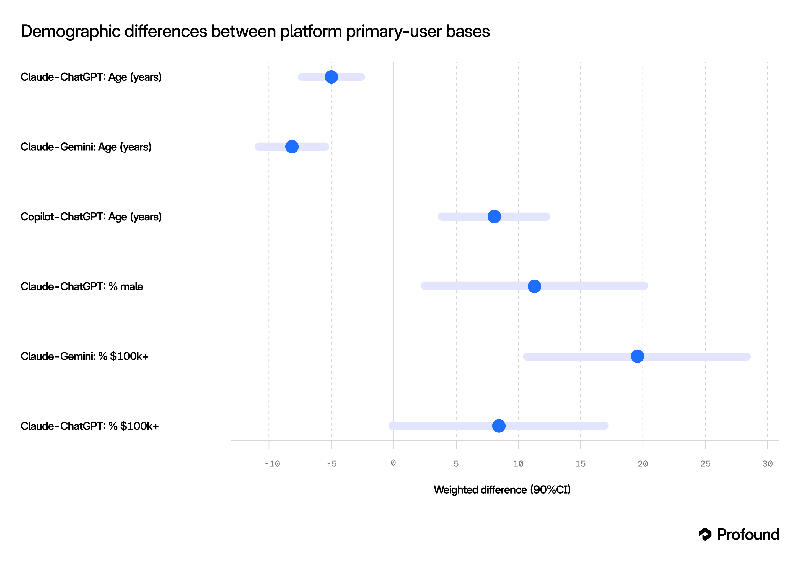
The study further revealed that consumers allocate their tasks based on platform strengths rather than personal preferences. For instance, younger users tend to favor Claude for coding jobs, while more mature users lean towards ChatGPT and Gemini for general inquiries. This behavior underscores a nuanced understanding of how different demographics interact with AI platforms, emphasizing the importance of tailoring services to meet user needs based on age and task sensitivity.
In conclusion, the study presents valuable insights into the AI assistant market, emphasizing that while brand names matter, user experience and trust built through interaction play a critical role in choice. As AI technology becomes increasingly integrated into daily life, understanding these dynamics will be essential for developers and marketers aiming to capture consumer loyalty in a rapidly evolving landscape.
Authors: Jennifer Zou*




