
Unveiled: How Laser-Electron Beam Interactions Could Redefine Our Understanding of Quantum Electrodynamics
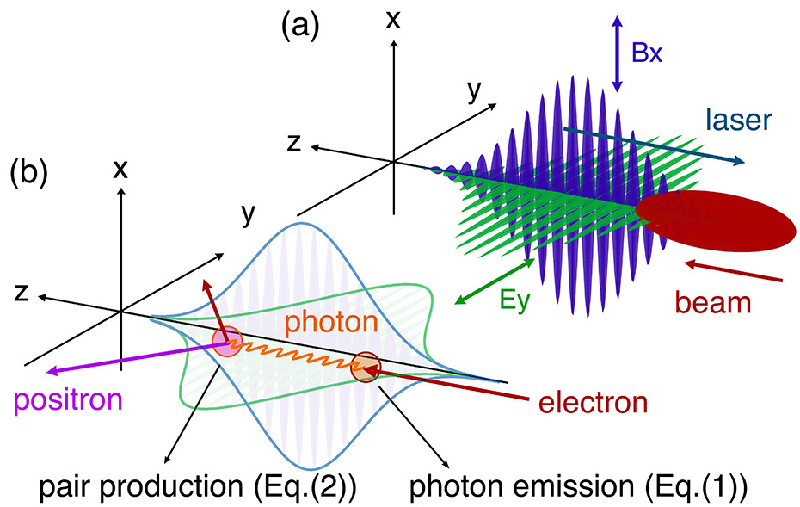
In a groundbreaking study, researchers from Japan are probing the depths of quantum electrodynamics (QED) through innovative experiments involving laser-electron beam interactions. This paper aims to examine the feasibility of precision counting experiments that focus on strong-field QED effects. By simulating these interactions and analyzing photon emission, polarization, and spin asymmetries, this research could pave the way for novel insights into fundamental quantum processes.
The Intricacies of Strong-Field Quantum Electrodynamics
At the heart of this research is strong-field QED, which aims to explain the behavior of charged particles and photons in the presence of intense electromagnetic fields. When these conditions are met—typically in extreme environments like neutron star magnetospheres—the interactions yield nonlinear behavior that can lead to phenomena such as pair production and radiation emission. This study focuses on how such processes operate under the unique conditions generated by intense laser pulses and relativistic electron beams.
Monte-Carlo Simulations: A Window into Rare Events
The researchers developed a sophisticated Monte-Carlo model that enables precise simulations of photon emissions from laser-electron interactions. This model employs multi-dimensional phase-space weighting, cumulative distribution functions, and variable time-steps to accurately reproduce particle behavior. One of the key innovations of this approach is its ability to encapsulate extremely rare emission events, offering unprecedented detail in tracking the outcomes of particle interactions.
Measuring Photon Polarization and Spin Asymmetry
Photon polarization and spin asymmetry are crucial factors in understanding the emitted photons during these high-energy processes. The study highlights that the emitted photons' polarization is influenced by the spins of the emitting electrons. By measuring these qualities in experimental setups like the proposed ELI-NP, researchers hope to provide insight into the underlying physics of strong-field QED. The anticipated experiments could lead to the first verifications of theoretical predictions about spin-dependent emission and pair production processes.
Looking Ahead: Implications for Future Experiments
The findings suggest that future experiments using sub-GeV electron beams and ultra-intense lasers, like those planned at ELI-NP, hold the potential to explore these quantum effects in more detail. The researchers argue that observing how the electron-beam energy and laser intensity interact could reveal new physics and confirm or refute existing theoretical models.
This study marks a significant step forward in our understanding of quantum interactions, swimming into the depths of electromagnetic phenomena with the fidelity of Monte-Carlo simulations. As researchers prepare for the next generation of experiments, the possibilities for unleashing the hidden complexities of our universe grow ever brighter.
Authors: Toseo Moritaka, Kensuke Homma, Kazunori Itakura




