
Unveiling New Frontiers in Software Debugging: The Impact of Visual Evidence on Issue Localization
A groundbreaking study introduces MM-IssueLoc, a benchmark redefining how software issues are localized by integrating visual evidence. This novel approach takes a step away from traditional text-only methods, reflecting a much-needed evolution in automated software engineering.
What Is MM-IssueLoc?
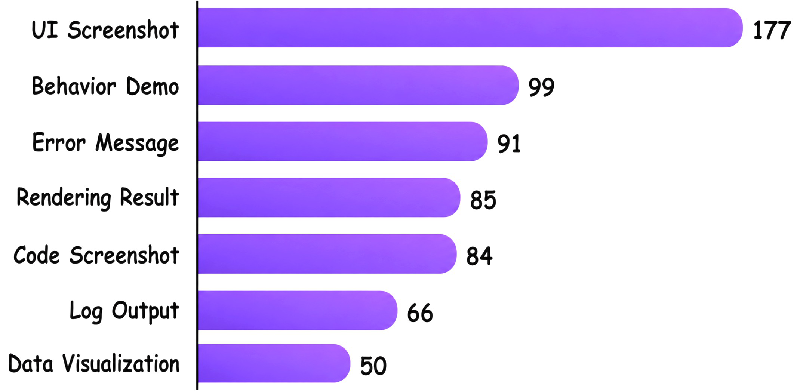
MM-IssueLoc is a controlled benchmark developed to address the limitations of existing evaluations that typically ignore visual elements associated with code issues. It encompasses a rich dataset of 652 real-world issues across 23 programming languages, complemented by annotated images, which include error messages, UI screenshots, and code snippets. The research highlights the role of these visual cues in guiding code localization, a crucial step in resolving software bugs.
The Need for Visual Evidence
In the realm of software engineering, developers frequently attach visual evidence, such as screenshots or error dialogs, alongside textual descriptions of issues. Traditional benchmarks have examined this process largely through a textual lens, failing to capture the substantial benefits visuals can provide. MM-IssueLoc aims to control for this variable, allowing researchers to directly assess the impact of visual inputs.
How Does MM-IssueLoc Work?
MM-IssueLoc features a detailed evaluation protocol that allows researchers to test various localization systems based on their use of visual evidence. The benchmark includes evaluation modes that isolate visual inputs from traditional text-only cues. In this way, developers can discern precisely how much visual evidence contributes to code localization success.
Key Findings: The Power of Visual Signals
The research team found that even the most advanced systems struggled with multimodal issue localization, achieving only modest accuracy levels (38.96% for file-level and 22.45% for function-level localization). The study concluded that while visual evidence could significantly enhance localization efforts, its inconsistency in exploitation across various systems remains a challenge.
Looking Ahead
MM-IssueLoc represents a significant advancement in making visual evidence a first-class citizen in the process of software debugging. As developers increasingly rely on visual cues to troubleshoot and resolve issues, benchmarks like MM-IssueLoc will play a crucial role in shaping future research and tool development in automated software engineering.
This comprehensive approach is set to ignite new conversations on the integration of multimodal inputs in coding practices, ensuring that software development evolves to meet the demands of modern applications.
For more insights and to access the benchmark, visit the official MM-IssueLoc repository.
Authors: {Shaoxiong Zhan, Shi Hu, Boyu Feng, Hai Lin, Andrew Gong, Zhengda Zhou, Jiaying Zhou, Yunyun Hou, Hao Su, Hai-Tao Zheng}




