
Unveiling Predictive Multiplicity: A New Paradigm for Auditing Decision Systems with Ensemble Models
In the intricate landscape of modern machine learning, the phenomenon of predictive multiplicity has emerged as a crucial factor influencing the reliability of AI decision systems. Recent research by Sinjini Banerjee, Tim Marrinan, and Anand D. Sarwate introduces a novel approach to understanding and mitigating the challenges posed by this phenomenon, particularly within ensemble models. Their work illuminates how the Rashomon effect, characterized by multiple models yielding distinct predictions despite similar accuracy, can be addressed effectively through innovative auditing techniques.
The Rashomon Effect and Predictive Multiplicity
The Rashomon effect refers to the observation that many different models can perform equally well on a given task while still exhibiting significant discrepancies in their predictions. This predictive multiplicity presents challenges, especially in high-stakes domains such as healthcare or finance, where inconsistent predictions can lead to serious consequences. Banerjee and colleagues emphasize that, while previous studies concentrated on understanding multiplicity within individual models, the implications for complex decision systems, including ensembles, have received inadequate attention.
Proposed Framework for Auditing Ensemble Predictions
The authors propose a comprehensive framework to analyze and audit ensemble predictions, focusing on two essential metrics: ensemble margin and local prediction variability. By combining these factors, they create a consistency measure known as (β, σ)-consistency, which provides valuable insights into how well an ensemble can maintain reliable predictions amid model multiplicity.
The Power of Ensembles in Reducing Errors
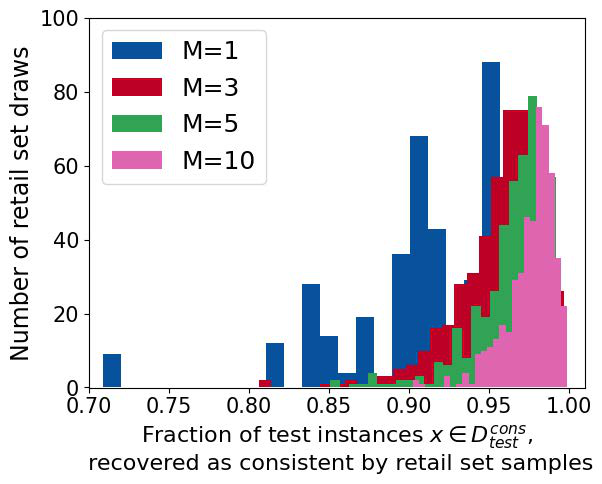
One of the core findings of this research is that using ensembles of models from the Rashomon set can significantly reduce the risk of incorrect predictions slipping through unchecked. In their experiments, the researchers utilized transformer models in natural language understanding tasks, demonstrating that audits based on ensemble consistency lead to fewer erroneous predictions compared to a single model. The results indicate that even modest-sized ensembles can closely approximate the performance of larger ones while maintaining high accuracy in auditing decisions.
Practical Implications and Future Directions
This research not only enhances our understanding of predictive multiplicity but also paves the way for developing more reliable machine learning systems. By operationalizing the (β, σ)-consistency measure within auditing applications, the framework provides a robust mechanism for identifying when a model's predictions should be escalated for human review. Looking ahead, the authors suggest that extending this framework to include weighted ensembles and adapting these auditing mechanisms for generative models could be crucial in improving the overall efficacy and trustworthiness of machine learning applications.
In summary, Banerjee, Marrinan, and Sarwate’s work offers compelling evidence that understanding and addressing predictive multiplicity through ensemble techniques can significantly elevate the reliability of machine learning systems, particularly in high-stakes environments.
Authors: Sinjini Banerjee, Tim Marrinan, Anand D. Sarwate




