
Unveiling the Cosmic Dance: The Fascinating Dynamics of Accreting Binary Black Holes
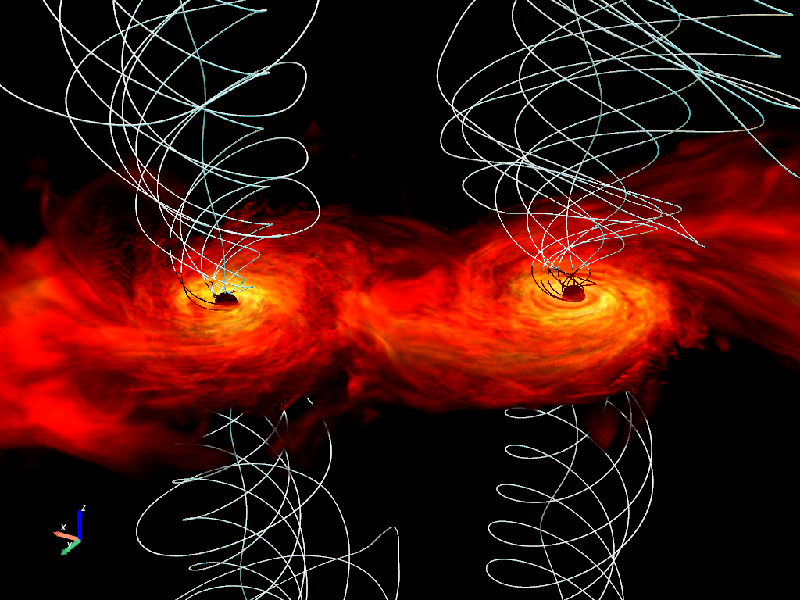
In a groundbreaking research study, astrophysicists have delved deep into the dynamics of supermassive binary black holes, bringing to light the intricate processes of accretion and magnetic interactions. With the title Magnetized accretion onto rapidly spinning binary black holes: mini-disk thermodynamics, magnetic transport, and dual jets, the paper highlights the unique behaviors of these celestial giants as they harvest gas and generate powerful jets.
Binary Black Holes: Cosmic Powerhouses
Nearly every massive galaxy harbors a supermassive black hole (SMBH) at its center. In our universe, these black holes often pair up, forming binaries as galaxies collide and merge. The study focuses on binaries comprising these SMBHs, which can accrete gas from their surroundings, generating electromagnetic emissions and powerful relativistic jets.
The Role of Mini-Disks in Accretion
One of the key findings of the research is the role of mini-disks. These structures form near the black holes due to gas captured from the outer circumbinary disk. The gravitational dynamics around the binary create complex flows and shocks, leading to effective mass transfer between these mini-disks and the black holes. This mass exchange influences the accretion rates and dramatically alters the luminosity of associated jets.
Magnetic Fields and Jet Dynamics
As the black holes accrete gas, magnetic fields play a crucial role. The study reveals how gas streams can transport magnetic flux into the mini-disks. This process is vital for the production of the jets that emanate from the black holes. Whenever coherent gas streams impact the mini-disks, they can generate significant outflows that are detected as powerful jets. The research also notes that these jets can alternate in strength, leading to fascinating periods of activity.
Variability and Its Impact on Observations
The researchers observed that the interaction between the mini-disks and the circumbinary disk results in substantial temporal variability. The periodicity of gas supply can directly influence the light emitted and the gravitational waves produced during black hole merger events. Such insights could potentially enhance our understanding of the cosmic events we observe through gravitational wave detectors and electromagnetic surveys.
Practical Implications and Future Research
The implications of this research extend far into the realms of theoretical astrophysics and observational astronomy. By refining our knowledge of how supermassive black holes behave in binary systems, scientists can better predict the properties of gravitational wave signals from black hole mergers. Furthermore, the dynamics of these dual jets could illuminate our understanding of galaxy formation and evolution in the universe.
In conclusion, the study of magnetized accretion in binary black holes uncovers a dynamic and intricate process that governs the cosmological landscape. As technology advances and observations deepen, the complex relationship between these cosmic giants continues to yield fascinating insights into the workings of the universe.
Authors: Luciano Combi, Manuela Campanelli, Sean M. Ressler, Alexander J. Dittmann, Federico Cattorini




