
Unveiling the Cosmic Mystery: How Cosmic Rays Illuminate Molecular Clouds and Create Multi-TeV Gamma-Rays
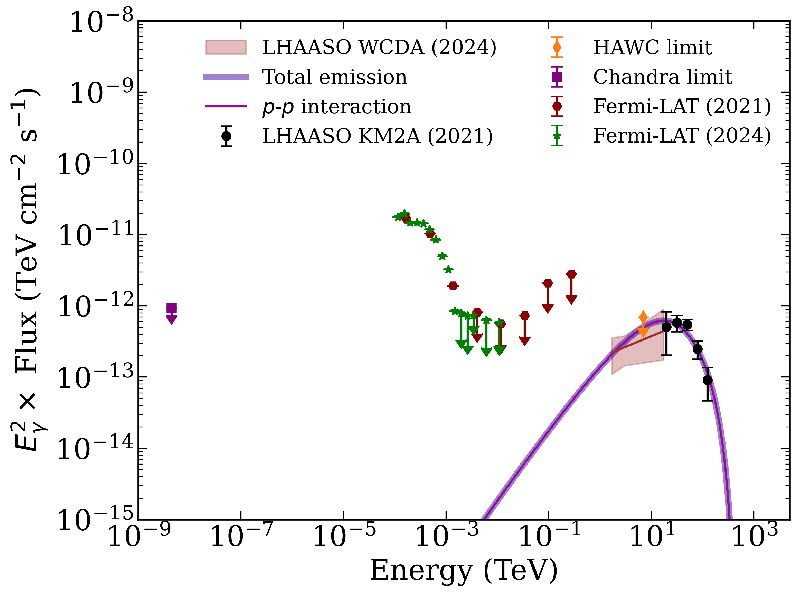
Recent research has plunged deep into the enigma surrounding ultra-high-energy (UHE) gamma-rays emanating from the source identified as LHAASO J0341+5258. These gamma-rays, with energies reaching into the multi-TeV range, have captivated the astrophysics community due to their potential implications for understanding cosmic particle accelerators.
Understanding the Significance of LHAASO J0341+5258
Discovered by the Large High Altitude Air Shower Observatory (LHAASO), LHAASO J0341+5258 stands out as an intriguing unidentified source of gamma rays. What makes this source particularly fascinating is the absence of a known astrophysical object within the immediate vicinity of the detected gamma-ray emission. This opens up a multitude of questions about the particles responsible for such high-energy emissions and what celestial phenomena might be acting as their accelerators.
The Role of Molecular Clouds
This research introduces a compelling theory: the gamma-rays may be a result of cosmic rays (CRs) interacting with nearby molecular clouds (MCs). In simple terms, these MCs are vast clouds of gas and dust in space, often sites for new star formation. The study proposes that the electrons and protons accelerated by supernova remnants—or other distant cosmic accelerators—can escape into these clouds, resulting in gamma-ray emissions due to particle interactions.
How the Study Works: Modeling Emissions
Two distinct frameworks were employed to model the emissions from LHAASO J0341+5258. The first approach leverages a computational model known as GAMERA to simulate how particles—once propelled away from an accelerator—propagate through the interstellar medium before interacting with molecular gas. The second approach analytically calculates the interactions between these cosmic rays, especially those emerging from a supernova remnant, and the dense molecular gas surrounding them.
Results and Implications
One of the key findings revealed that under realistic conditions concerning the distance and properties of the cosmic rays and molecular clouds, the models could successfully reproduce the observed gamma-ray spectrum from LHAASO J0341+5258. This suggests that these molecular clouds could act as long-lived storage sites for the signatures of past cosmic particle accelerations, helping to clarify the nature of sources like LHAASO J0341+5258.
Conclusions: A Step Toward Understanding the Universe
The implications of these findings could reshape our understanding of cosmic ray propagation and the nature of particles accelerated in various environments across our Galaxy. As high-energy gamma-ray astronomy continues to evolve, future research is essential to unravel these cosmic mysteries, potentially leading to groundbreaking discoveries about the universe’s most enigmatic components.
In summary, this study highlights not only the exciting nature of gamma-ray emissions from LHAASO J0341+5258 but also how molecular clouds serve as crucial players in unraveling the mysteries of high-energy astrophysics.
Authors: Abhijit Roy, Alan Sunny, Martina Cardillo, Jagdish C. Joshi, Ritabrata Sarkar




