
Unveiling the Dynamics of Lipid Vesicles: How Osmotic Shocks Drive Dramatic Shape Transformations!
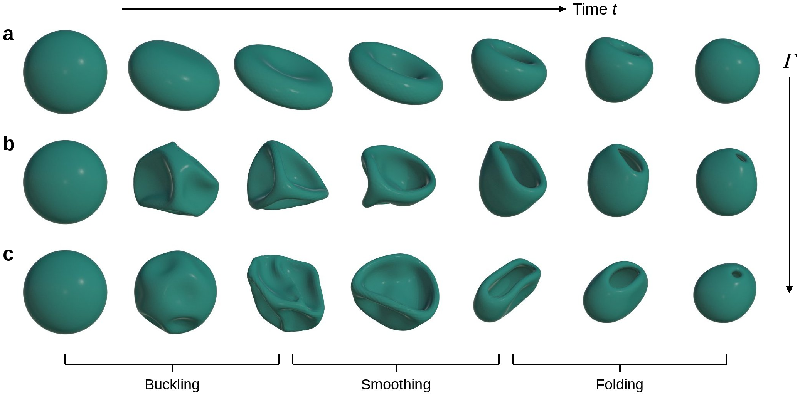
Recent research from Nicholas Broussinos and David Saintillan at the University of California San Diego reveals fascinating insights into how lipid vesicles—tiny, spherical structures that form the basis of cell membranes—respond to osmotic stress. By simulating these vesicles under osmotic shock, the study offers a continuum perspective on the mechanics governing their dynamic shapes.
The Mechanics of Osmotic Shock
In essence, lipid vesicles are like balloons filled with liquid, encased in a flexible membrane. When subjected to a sudden change in the surrounding solute concentration—known as osmotic shock—their shape can drastically change. This study identifies the key role of bending elasticity and surface viscosity in driving these transformations.
Three Stages of Vesicle Deformation
The research categorizes the vesicle's response into three distinct stages. First, an initial rapid buckling occurs as the balloon-like structure reacts to the pressure difference across its membrane. This is followed by a smoothing phase where sharp wrinkles and folds formed during buckling start to disappear, creating a more stable configuration. Finally, the vesicle undergoes a slow folding process, evolving into an 'invaginated' morphology, akin to structures sometimes observed in biological processes.
Key Findings: From Collapse to Morphology
One remarkable outcome of this research is the prediction of how quickly these transformations happen. The study establishes that the timescales for buckling and folding can be understood through mathematical scaling laws. Specifically, researchers found that the buckling time scales as the inverse square of the osmotic pressure difference, making it highly sensitive to changes in this pressure.
The Role of Surface Viscosity
A particularly interesting aspect of the findings is the role of surface viscosity. It was found that not only does it affect how quickly shapes can change, but it also participates in energy dissipation during these transformations. This implies that the traditional understanding of elastic materials might not fully capture the behavior of lipid membranes, which are more fluid-like in their response.
Real-World Implications
Understanding the dynamics of lipid vesicles is vital for various applications in biophysics and synthetic biology, such as drug delivery systems, where the manipulation of vesicle shapes could lead to more efficient methods of transporting therapeutic agents into cells.
This groundbreaking study sheds light on the complexities of biological membranes and paves the way for further exploration of their capabilities in synthetic contexts. As researchers continue to delve into the world of lipid dynamics, we may uncover even more astonishing behaviors of these fundamental building blocks of life.


