Breakthrough Theory Could Explain Saturn's Mysteries
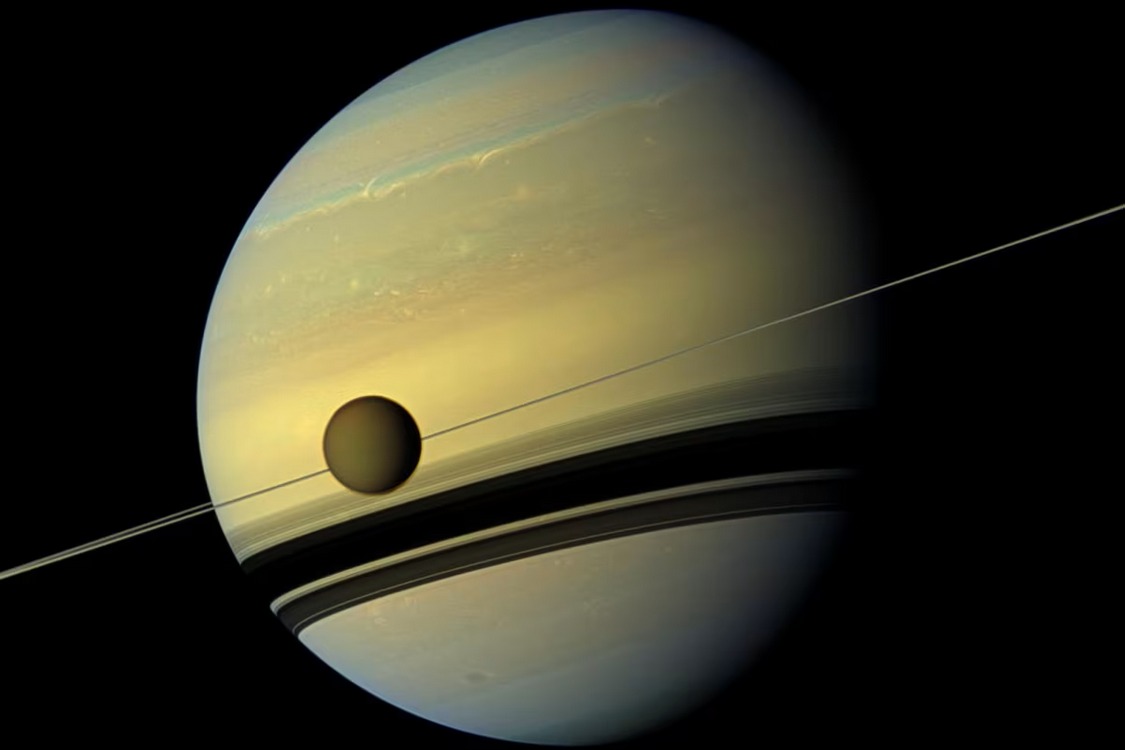
Exciting developments in space science have emerged as researchers propose a groundbreaking theory regarding the formation of Titan, Saturn's largest moon. Matija Ćuk, a research scientist at the SETI Institute, has put forth a compelling explanation that could resolve longstanding questions about Titan's unusual size and Saturn's notable wobble and tilt.
New Insights from Cassini Data
Using data obtained from NASA's Cassini Probe, which studied Saturn and its moons from 2004 to 2017, along with innovative computer simulations, Ćuk suggests that Titan's size may be a result of a collision with another moon in Saturn's ancient past. This event, he theorizes, not only contributed to Titan’s growth but may also have played a significant role in the formation of Saturn's iconic rings.
Resonance and Cosmic Collisions
Previously, scientists considered Neptune's orbital forces as a potential cause for Saturn's tilt, but Ćuk's research presents a more refined understanding. He argues that the resonances among Saturn’s moons demonstrate a complex interaction that could be clarified by introducing the idea of an additional, now-lost moon. This collision theory appears to align much more closely with empirical observations than prior hypotheses.
Supporting Voices in Astronomy
Expert voices within the scientific community are lending credence to Ćuk's findings. William B. Hubbard, a professor emeritus of planetary sciences, and Carl Murray, associated with the Cassini team, both express optimism regarding the new theory's potential to accurately explain Titan's characteristics and Saturn's behavior. Collective insights from these thought leaders help to reinforce the notion that there is still much we do not know about our solar system and that the journey of discovery is far from over.
This latest research highlights not only the marvels of our solar system but also the continued advancements in our understanding of cosmic phenomena. As the scientific community delves deeper into these celestial puzzles, the prospect of uncovering more truths about our universe remains tantalizingly alive.

