Revolutionary Theory Explains the Enigma of Saturn’s Largest Moon
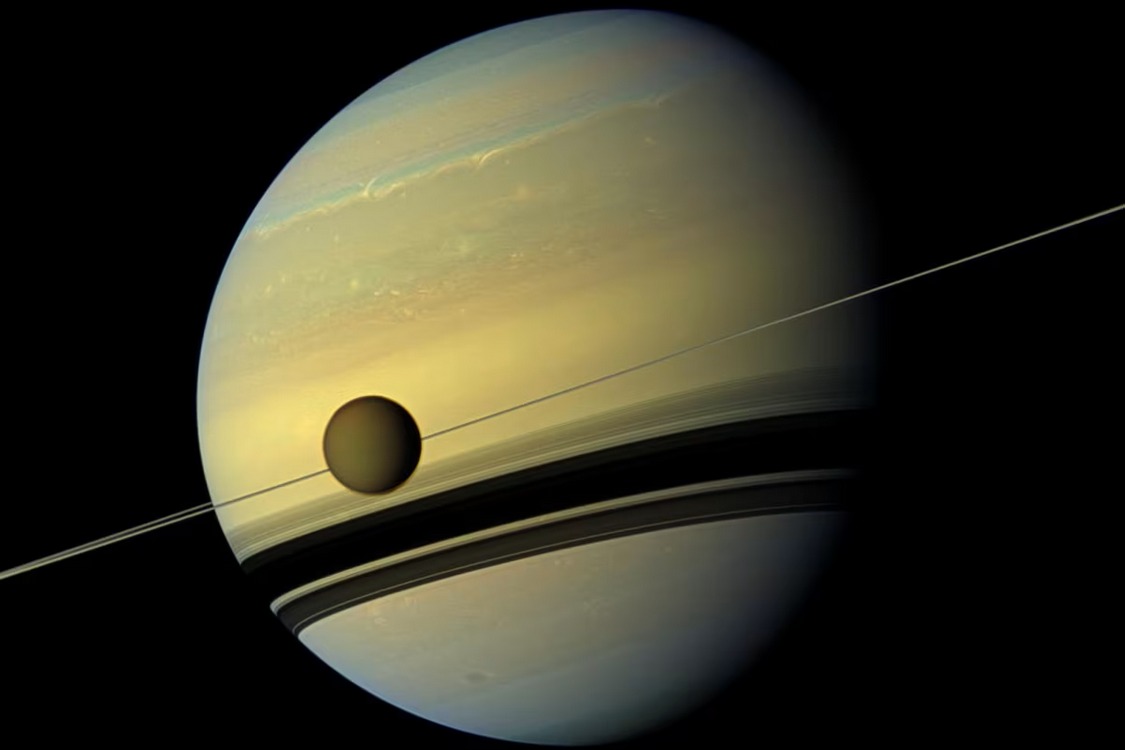
A groundbreaking new theory put forth by Matija Ćuk, a research scientist at the SETI Institute, may have unlocked the secrets behind Titan, Saturn's largest moon, and its intricate relationship with the planet's tilt and wobble.
Unraveling a Cosmic Mystery
Titan, larger than Mercury and enveloped in an atmosphere, has intrigued scientists for years. Despite its prominence, the exact reasons behind its significant size and gravitational influence on Saturn remained elusive until now. Ćuk proposes that a long-lost moon collided with Titan in a cataclysmic event, considerably increasing its size and affecting Saturn's dynamics.
A New Perspective on Saturn's Rings
Ćuk's extensive research, which combines data from NASA's Cassini Probe and sophisticated computer simulations, suggests that this ancient collision not only explains Titan's massive size but also sheds light on Saturn's distinctive rings. The theory posits that the impact could have initiated a series of interactions that later produced the rings we see today, estimated to have formed around 100 million years ago.
Scientific Validation of the Theory
Prominent experts in the field of astronomy have responded positively to Ćuk's research. William B. Hubbard, a professor emeritus at the University of Arizona, and Carl Murray from Queen Mary University of London both concur that Ćuk's hypothesis offers a more plausible explanation than previous theories concerning Saturn's peculiar behavior.
This recent study, soon to be published in The Planetary Science Journal, not only enhances our understanding of Titan but also emphasizes the importance of continuous exploration and inquiry in astronomy. With the incredible capabilities of tools like the James Webb Space Telescope, humanity stands on the brink of discovering even more about our solar system.

