The Cosmic Puzzle of Saturn's Moons: A New Theory Unveiled
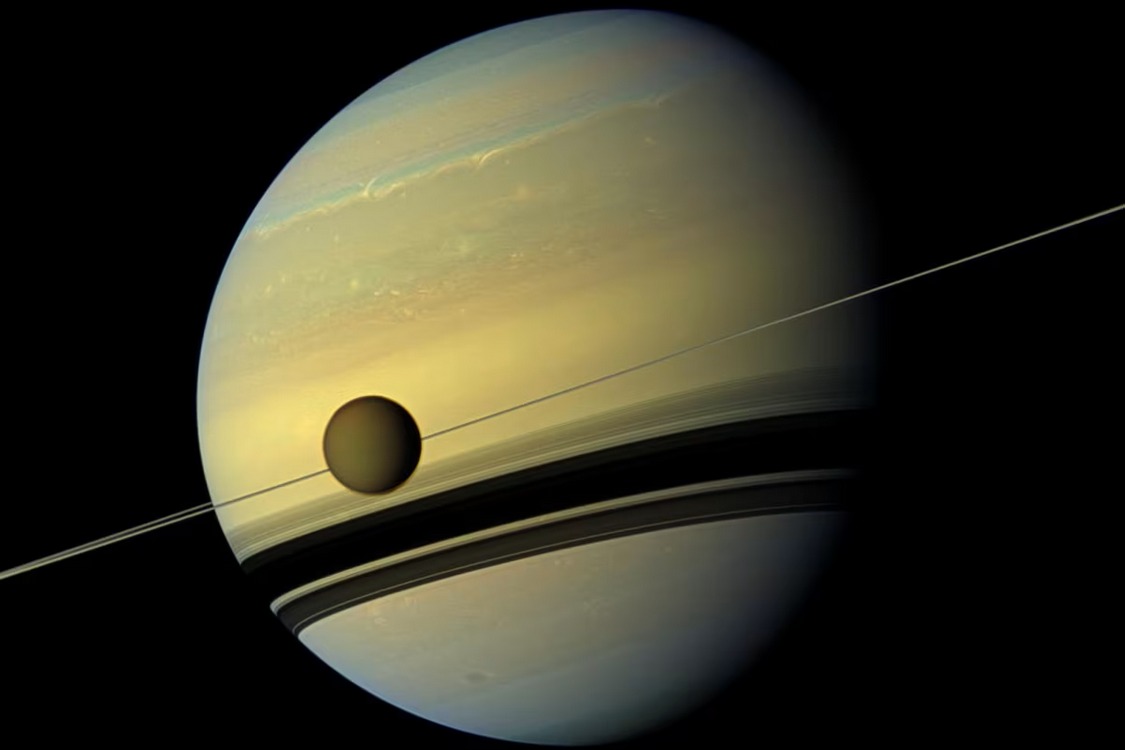
A groundbreaking theory has emerged that could finally demystify the origins of Titan, Saturn's largest moon, which has captivated scientists for decades. Research by Matija Ćuk from the SETI Institute suggests a colossal collision of moons could be responsible for Titan's impressive size and the unique characteristics of Saturn itself.
Unraveling the Mystery
With Titan being larger than Mercury, its formation has puzzled astronomers significantly. Ćuk's research presents a compelling new narrative: an ancient moon, hypothesized to have been in the Saturnian system, collided with Titan. This event not only increased Titan's mass but may have also influenced Saturn's tilt and wobble, which have been observed but not fully understood until now.
The Innovative Research Methodology
Utilizing data from NASA’s Cassini Probe, which operated from 2004 to 2017, alongside new computer simulations, Ćuk has put forth a theory that aligns with observations of Saturn’s gravitational dynamics. His model proposes that this colossal collision initiated a series of events that formed Saturn’s iconic rings and adjusted its wobble, effectively explaining anomalies previously attributed to other causes.
A Shift in Understanding
Previously accepted theories, such as those proposing that Neptune’s orbital forces explained Saturn’s resonance, failed to adequately account for these observations. Ćuk's new findings provide a more comprehensive framework, aligning closely with the collected data. This evolution in thought marks a noteworthy advancement in planetary science, allowing for a deeper understanding of the interactions between celestial bodies.
Community Response and Future Implications
The astronomical community has greeted Ćuk's findings with enthusiasm. Notable figures like Professor William B. Hubbard from the University of Arizona and Carl Murray from Queen Mary University of London both endorse the theory, emphasizing its greater explanatory power compared to earlier hypotheses. This validation could encourage further exploration of Saturn's system and shed light on the dynamics of moon formation and planetary evolution in general.
The implications of this research stretch far beyond Titan and Saturn. As we delve deeper into our solar system, findings like these inspire a sense of wonder and anticipation about what other mysteries await discovery. The universe continues to present challenges and enigmas that propel scientific inquiry forward, showcasing the ever-evolving nature of our understanding of space.

